
Blog
Insights
Straightforward interfaces make navigation and actions more intuitive, reducing the learning curve for new users.

Matt Allison
Founder & CEO

Key Takeaways
Understanding narrative intelligence is the difference between reacting to your reputation and engineering it.
Narrative intelligence goes beyond sentiment scores and mention counts to reveal the actual storylines shaping how audiences—and AI systems—perceive your brand.
Unlike traditional media monitoring, narrative intelligence surfaces which stories are gaining momentum before they reach mainstream coverage, enabling proactive intervention rather than damage control.
AI and large language models now synthesize brand coverage into consolidated narratives encountered by millions of users daily, making narrative-level visibility a core communications imperative.
Communications teams that apply narrative intelligence can compress quarter-long analysis cycles into real-time insight, shifting from documentation to strategic decision-making.
If your team is still measuring reputation by mention volume, the stories forming around your brand are already being written without you.
The premise of media monitoring was simple: track where your brand appears, count the mentions, and report the results. For a long time, that was enough. But when coverage could be compiled into a quarterly report without much urgency, the lag between signal and action was tolerable. That era is over.
Today, a reputation-shaping narrative can form, spread, and become embedded in AI-generated responses in the time it takes most teams to schedule a review meeting. The data problem communications leaders face isn't a shortage of information—it's a shortage of meaning. And that's exactly what narrative intelligence is designed to provide.
This guide covers what narrative intelligence is, how it differs from sentiment analysis and traditional monitoring approaches, and how enterprise communications teams can apply it to move from reactive tracking to proactive strategy. For organizations competing at scale, it's not just a useful upgrade—it's the difference between shaping perception and responding to it.
What Is Narrative Intelligence?
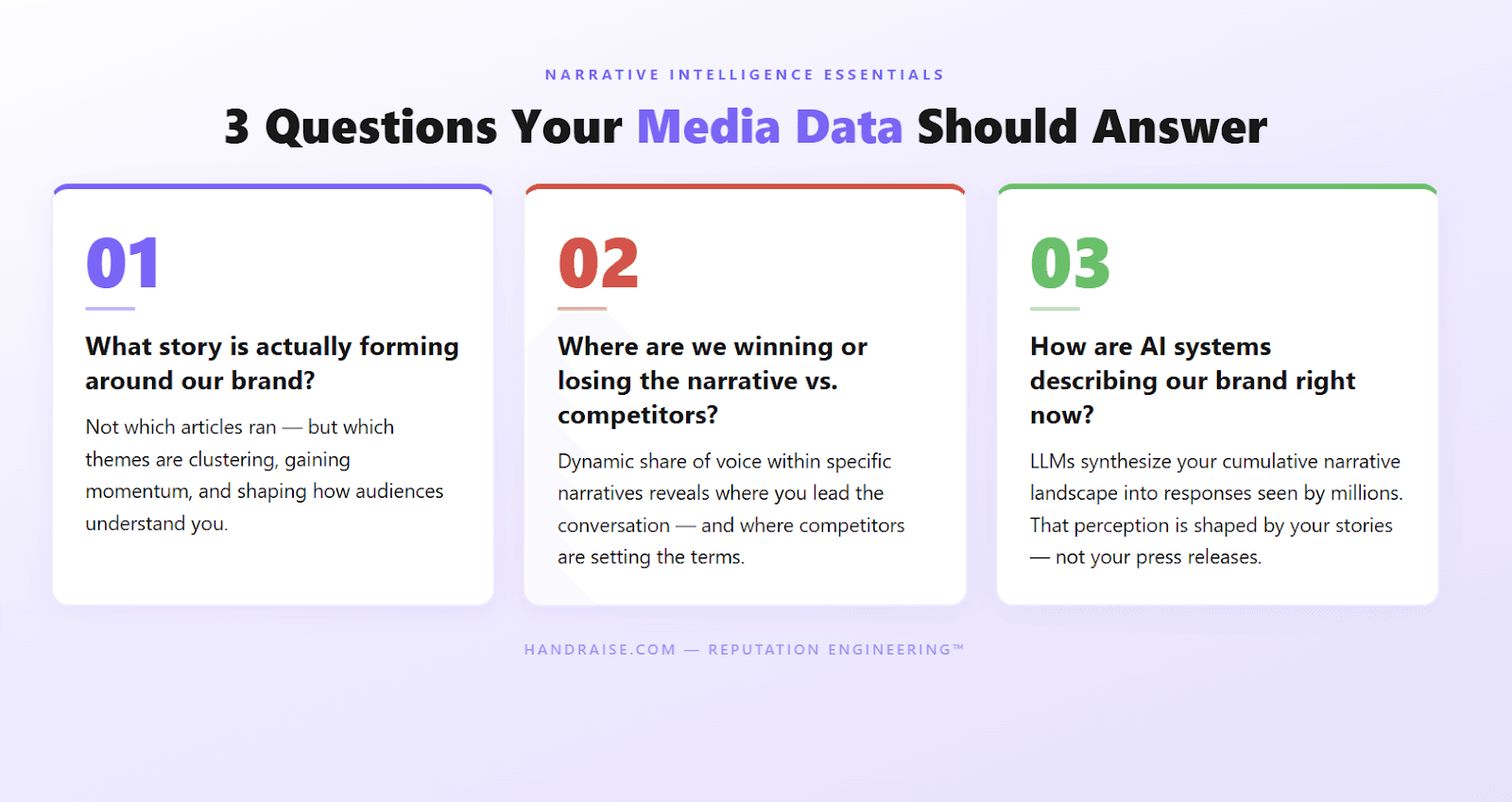
At its core, narrative intelligence is the practice of detecting, analyzing, and acting on the storylines that form across media coverage, public discourse, and AI-generated content. Rather than cataloging individual mentions, it maps the connected themes, recurring frames, and directional momentum of the stories being told about a brand, an industry, or a topic.
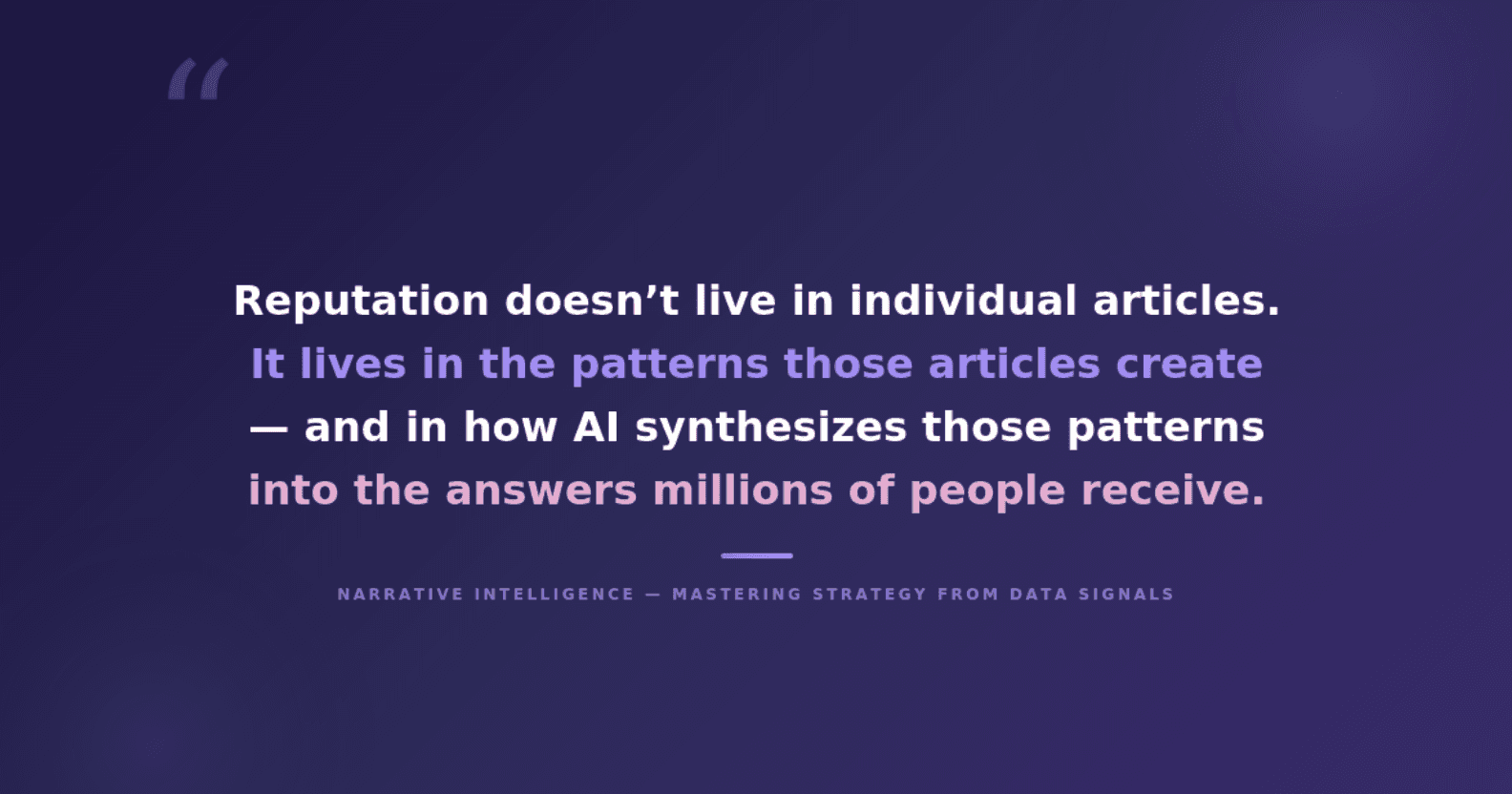
The distinction matters because reputation doesn't live in individual articles. It lives in the patterns those articles create over time—the recurring themes that audiences absorb and that AI systems synthesize into summary answers. A single critical piece rarely damages a brand. A cluster of related stories telling the same unfavorable story absolutely can.
Narrative intelligence is designed to surface those clusters. It answers questions that raw data cannot: What overarching story is being told about us? Who is driving it? Where is it gaining momentum? Is it reaching the media outlets that carry the most weight with our stakeholders? And critically—is it the story we want being told?
This approach has become essential not just for reputation management, but for understanding how media intelligence shapes strategy at every level of the communications function. According to the USC Annenberg Center for Public Relations 2025 Global Communication Report, 60% of PR professionals now believe AI will benefit the industry—but only those equipped with the right intelligence infrastructure will be positioned to capture that advantage. A separate survey by WE Communications and USC Annenberg found that two-thirds of communicators now use AI frequently, with 70% reporting it improves their work quality. The gap between organizations that have modernized their narrative monitoring capabilities and those still running quarterly clip reports is widening fast.
The Evolution From Mentions to Narratives
The communications industry has moved through three distinct phases of how it processes media data.
The first phase was basic media monitoring: clip collection, mention counting, and periodic reporting. This approach answered "where did we appear?" but little else. It produced high volumes of raw data that required extensive manual interpretation—and by the time that interpretation was complete, the news cycle had often moved on.
The second phase introduced sentiment analysis: attaching positive, negative, or neutral scores to individual pieces of coverage. This was a meaningful step forward, but still incomplete. Sentiment scores on isolated mentions miss context, fail to account for brand prominence within a piece (a headline mention versus a passing reference), and can't reveal the narrative arc forming across hundreds of related articles. Two brands can both have 60% positive sentiment scores and have completely different reputation trajectories, depending on which stories are gaining momentum.
Narrative intelligence is the third phase—and the one that finally answers the strategic question every VP of Communications actually needs: What story is the world telling about us right now, and where is it headed?
How Narrative Intelligence Differs From Sentiment Analysis
Sentiment analysis and narrative intelligence are frequently conflated, and understandably so—both involve analyzing media coverage and both inform reputation management. But they operate at fundamentally different levels of abstraction, and confusing them leads to a very common strategic blind spot.
Sentiment analysis is article-level. It evaluates tone within individual pieces of coverage: is this article favorable, unfavorable, or neutral? Done well, it can distinguish between brand-centric sentiment (how the brand itself is framed) versus general topic sentiment (how the subject matter is covered overall). That distinction matters enormously—a positive article about industry innovation that barely mentions your brand isn't a win.
Narrative intelligence is story-level. It groups related articles into clusters, identifies the themes driving those clusters, and tracks their momentum over time. Where sentiment analysis tells you the temperature of a single piece, narrative intelligence tells you the direction of the weather system forming across dozens or hundreds of pieces.
Consider the practical difference. Sentiment analysis might show that your brand's coverage skewed 65% positive last quarter. Narrative intelligence would reveal that the top two narratives driving that coverage are "innovation leadership" and "executive transition," that the innovation narrative is growing while the executive narrative is plateauing, and that a third cluster around customer experience is emerging with mixed sentiment and increasing publication volume. Those are three completely different strategic implications—none of which would be visible from sentiment scores alone.
There's also a dimension that neither traditional sentiment analysis nor basic monitoring addresses at all: AI and LLM perception. Large language models now function as research tools for millions of users every day. When someone asks an AI assistant about your company, your competitors, or your industry, the response they receive is synthesized from the cumulative narrative landscape around your brand—not from your latest press release or most recent campaign. This makes understanding how AI systems perceive your brand narratives a core intelligence function, not an optional one.
Capability | Sentiment Analysis | Narrative Intelligence |
Unit of analysis | Individual article | Clustered storylines |
Output | Positive/negative/neutral score | Narrative themes, momentum, trajectory |
Time orientation | Backward-looking | Real-time + forward-looking |
Coverage context | Raw tone | Brand prominence + publication authority |
Competitive view | Limited | Dynamic share of voice across narratives |
AI/LLM relevance | Not addressed | Core component |
Strategic value | Reporting | Decision-making |
Why Has Narrative Intelligence Become a Strategic Communications Priority?
For most of the last decade, the case for better media analytics was largely a productivity argument: reduce manual work, speed up reporting, clean up messy data. Those are real problems, but they undersell the actual urgency.
The strategic case for narrative intelligence rests on three structural shifts that have fundamentally changed how reputation forms.
The Acceleration of Narrative Formation
Coverage cycles are faster. Social amplification is instant. A storyline that might once have taken months to crystallize into settled perception can now reach critical mass in days. Most communications teams are still operating on quarterly review cycles—which means the narratives defining their brands are routinely set by the time the analysis arrives. This timing gap isn't a minor inefficiency. It's a strategic vulnerability.
Real-time narrative monitoring compresses that gap to zero. Rather than discovering last quarter's dominant narrative, communications leaders see which clusters are forming today, which are gaining editorial traction, and which sources are driving them. That intelligence makes the difference between shaping a story while it's still fluid and defending against one that's already calcified.
The LLM Factor: AI Is Now a Critical Audience
This is the shift most communications teams are least prepared for. Large language models—ChatGPT, Gemini, Perplexity, Claude, and dozens of others—are now primary research interfaces for an enormous number of users. ChatGPT alone surpassed 800 million weekly active users as of late 2025, and AI-driven discovery is accelerating across every category.
The implications for brand reputation are significant. LLMs don't evaluate each piece of coverage independently. They synthesize the cumulative narrative around a brand into consolidated responses. A company that has managed negative coverage at the article level may still find that AI systems describe it in unflattering terms—because the underlying storyline threading through months of coverage has created a durable pattern that AI systems have absorbed.
This means AI perception monitoring is no longer a future investment—it's an immediate priority. The broader communications market is moving quickly: the global PR industry is projected to reach $143 billion by 2029, and organizations competing in that environment need communications infrastructure that can match the pace of modern narrative formation. Brands with proactive narrative strategies are more likely to appear accurately and favorably in AI-generated responses. Those without them risk having outdated or competitor-favorable storylines define their AI presence by default.
The Complexity of Modern Coverage Landscapes
Enterprise brands operate across dozens of products, regions, topics, and stakeholder groups simultaneously. Traditional monitoring treats all coverage as roughly equivalent. Narrative intelligence applies the nuance those environments require: weighting mentions by publication authority and domain reach, distinguishing between headline coverage and passing references, segmenting narrative performance by topic cluster, and surfacing competitive positioning within specific storylines rather than just overall.

The Core Components of a Narrative Intelligence Framework
Understanding what narrative intelligence is forms the foundation. Applying it requires a clear framework. These are the building blocks that enterprise communications teams need in place.
Here are the five essential components that make narrative intelligence operational:
Real-time narrative clustering: AI-powered grouping of related coverage into thematic storylines, updated continuously rather than compiled periodically. This is what transforms hundreds of individual articles into a manageable set of strategic themes.
Brand-centric sentiment analysis: Sentiment scoring calibrated specifically to how your brand is framed—not the general tone of the article—with distinctions for headline prominence versus passing mentions.
Publication tiering: Weighting coverage by domain authority and readership, so a feature in a high-authority trade publication registers differently from a passing reference in a low-traffic blog.
Dynamic share of voice: Tracking competitive positioning within specific narratives, not just overall mention volume. This reveals where you're leading the conversation versus where competitors are setting the terms of the story.
LLM impact tracking: Monitoring how AI systems synthesize your brand's narrative landscape and identifying which storylines are shaping AI-generated responses.
From Data Signals to Actionable Strategy: A Practical Framework
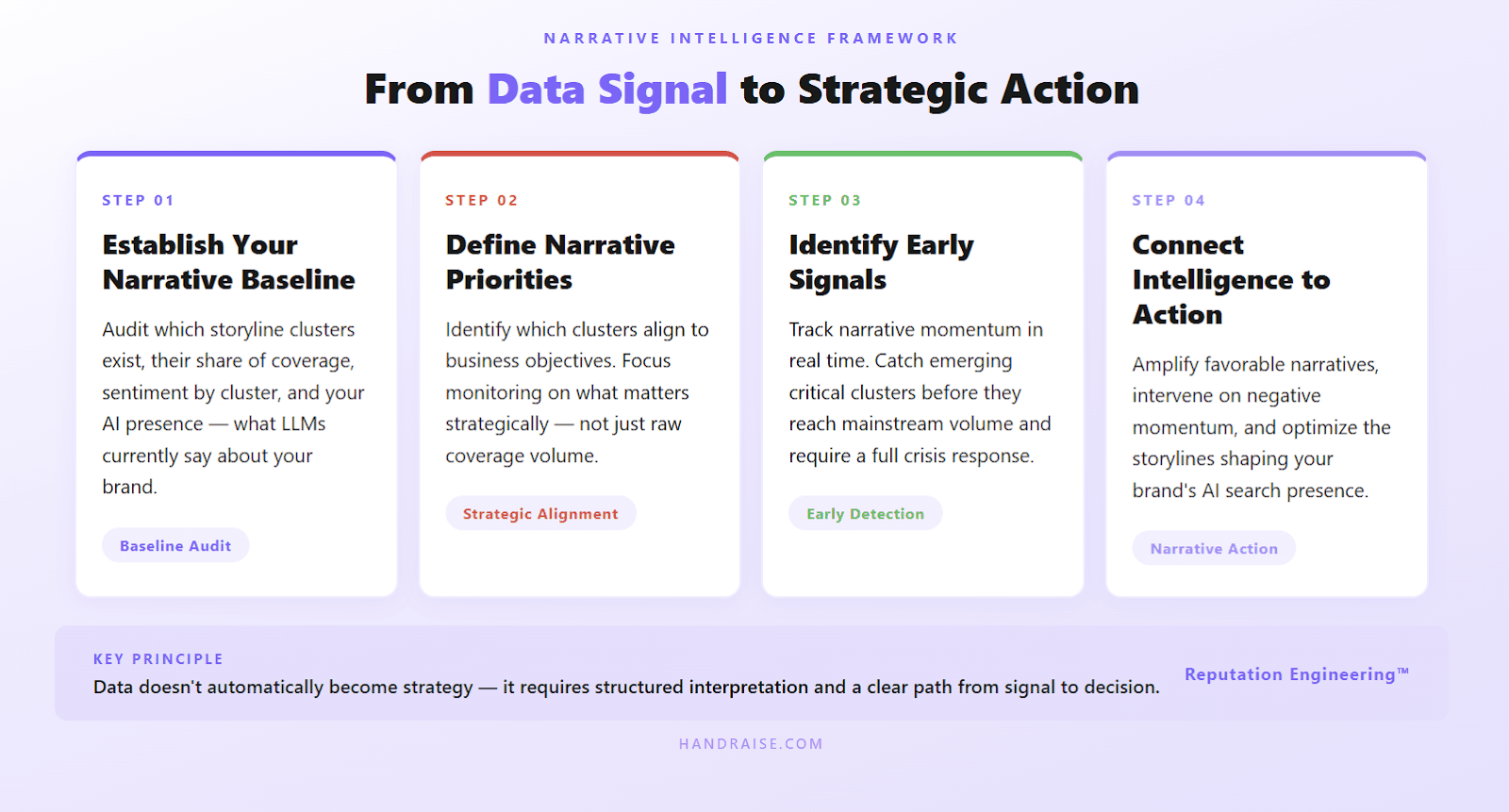
The gap between having narrative intelligence and using it strategically is where most teams struggle. Data doesn't automatically become strategy—it requires a structured approach to interpretation and action. Here's how to move from signal to decision.
Step 1: Establish Your Narrative Baseline
Before you can track narrative momentum, you need to know where you're starting. A baseline audit examines the current storyline landscape around your brand: which narrative clusters exist, what share of recent coverage each commands, how sentiment breaks down within each cluster, and how your narrative position compares to key competitors.
This baseline also includes a diagnostic of your AI presence—what LLMs currently say about your brand, your competitors, and your category. That starting point reveals which narratives have already become embedded in AI-generated responses and which need proactive attention.
Step 2: Define Narrative Priorities
Not all stories carry equal weight. Some narratives are central to your brand's strategic positioning; others are peripheral. Defining which clusters matter most—and what "success" looks like within each—is the critical planning step that most teams skip.
Narrative priorities should align with business objectives: if a product launch is the top priority, narratives around innovation and quality are most relevant. If regulatory scrutiny is the environment, narratives around compliance and governance need active management. This alignment is what turns narrative intelligence from an analytics function into a strategic communications driver.
Step 3: Identify Early Signals
The most valuable application of narrative intelligence isn't explaining what happened—it's catching what's forming. This requires tracking narrative momentum: which clusters are growing, which are stabilizing, and which emerging themes might coalesce into larger stories.
Narrative momentum and sentiment shifts serve as warning signals, allowing brands to intervene before an initially niche criticism picks up speed across multiple media communities and requires a full crisis response.
This early signal capability is what enables the shift from reactive to proactive strategic communications—the difference between responding to headlines and shaping the stories that eventually become them.
Step 4: Connect Intelligence to Action
Narrative intelligence is only as valuable as the actions it enables. The final step in this framework connects each narrative priority to a specific response strategy:
Amplification: For narratives that align with brand positioning and are gaining positive momentum, identify ways to accelerate coverage through earned media, executive thought leadership, or campaign activity.
Intervention: For narratives with negative momentum, determine whether the appropriate response is direct rebuttal, counter-narrative development, or strategic silence—and act before the story reaches mainstream saturation.
Optimization: For AI and LLM narratives specifically, identify which storylines are driving AI responses about your brand and develop content strategies to influence those underlying sources.
What Narrative Intelligence Reveals That Traditional Monitoring Misses
One of the most common objections to narrative intelligence is the assumption that existing monitoring tools cover the same ground. They don't—and the gaps are strategic, not technical.
Monitoring Question | Traditional Tools | Narrative Intelligence |
Where did we appear? | ✓ | ✓ |
What tone did coverage take? | Partially | ✓ (brand-specific) |
What story is forming across articles? | ✗ | ✓ |
Which narratives are gaining momentum? | ✗ | ✓ |
How do competitors compare within each storyline? | ✗ | ✓ |
How are AI systems describing our brand? | ✗ | ✓ |
What should we do right now? | ✗ | ✓ |
This comparison matters because the questions in the bottom half of that table are exactly what VP-level communications leaders need to answer for executive leadership. The standard deliverable from traditional monitoring—a clip report with sentiment scores—answers the first two questions. It leaves every strategic question unanswered.
The smartest communications strategies focus on authority and contextual relevance, not raw volume—and AI-driven engines that compress and reframe narratives make this more urgent than ever.
Applying Narrative Intelligence to Strategic Communications
Narrative intelligence isn't a standalone capability—it integrates across every dimension of an enterprise communications strategy. Here's where it creates the most tangible impact.
Campaign Planning and Pre-Launch Intelligence
Before any major campaign or announcement, narrative intelligence reveals the existing storyline landscape your message will enter. Which themes are already top-of-mind with your key media contacts? Which narratives have your competitors established in this space? Where does genuine white space exist that your brand can credibly claim?
This context shifts campaign planning from hypothesis to evidence—and dramatically improves the odds that the narrative your campaign intends to create actually takes root rather than being absorbed into an existing, competitor-favorable storyline. An effective media strategy is built on what coverage data actually shows is gaining traction, not just on what internal stakeholders assume is resonant with their audiences.
Crisis Detection and Reputation Risk Management
The most expensive communication moments are the ones that could have been caught earlier. Narrative intelligence dramatically improves early detection by tracking sentiment shifts and emerging clusters in real time, not in quarterly review.
A small cluster of critical articles about a specific product issue, a growing pattern of negative sentiment around a recent executive decision, or an emerging competitor narrative that could pull your share of voice—these are all visible in narrative intelligence dashboards long before they reach the volume threshold that triggers traditional alerts.

Measuring What Actually Matters
Communications leaders have long struggled with the gap between the metrics they can report—impressions, clip counts, mention volume—and the outcomes executive leadership actually cares about: reputation, competitive positioning, and business impact.
Narrative intelligence bridges that gap by measuring the PR analytics that matter to executive leaders: narrative share within strategic themes, sentiment trajectory on brand-critical clusters, and competitive position across the storylines that define your category.
Competitive Share of Voice at the Narrative Level
Traditional share of voice is a blunt instrument. It tells you how your mention volume compares to competitors overall, but says nothing about where you're winning or losing within specific strategic narratives. Dynamic share of voice—tracking competitive positioning within each narrative cluster—reveals far more useful intelligence.
A brand might have 40% overall share of voice but dominate the innovation narrative while trailing on sustainability. That breakdown informs where to concentrate earned media efforts for maximum strategic impact, rather than optimizing for volume at the expense of narrative quality.
Agency and Team Alignment
Narrative intelligence also transforms how enterprise communications teams work with external agency partners. Rather than briefing agencies on broad goals and hoping coverage aligns, teams can share specific narrative targets, track how agency-generated coverage contributes to desired storyline momentum, and measure impact at the narrative level rather than by clip count.
This kind of targeted alignment is increasingly important as communications functions grow in complexity and the expectation for demonstrable ROI from earned media investments rises accordingly.
Frequently Asked Questions About Narrative Intelligence
What's the difference between narrative intelligence and media monitoring?
Media monitoring tracks where and when your brand appears across publications and channels. Narrative intelligence goes further by clustering related coverage into thematic storylines, tracking the momentum and sentiment within each cluster, and surfacing which narratives are forming before they reach mainstream attention. Monitoring answers "where did we appear?"—narrative intelligence answers "what story is forming, and where is it heading?"
How does narrative intelligence connect to AI and LLM perception?
Large language models synthesize the cumulative narrative around a brand from thousands of sources to generate responses about your company, your competitors, and your category. Narrative intelligence tracks which storylines are most prominent in your coverage landscape and, by extension, which are most likely to be absorbed and repeated by AI systems. Brands that proactively shape their narrative landscape have significantly better outcomes in AI-generated responses than those that leave it to chance.
Can narrative intelligence actually prevent a PR crisis?
No system prevents all crises, but narrative intelligence dramatically improves early detection. By tracking the formation of negative storylines in real time—rather than discovering them through quarterly reporting—communications teams can identify emerging reputational risks and intervene before the story reaches mainstream coverage or becomes embedded in AI-generated responses about the brand.
How is brand-centric sentiment different from general sentiment analysis?
General sentiment analysis scores the overall tone of an article. Brand-centric sentiment specifically analyzes how your brand is framed within that coverage—distinguishing between a headline feature with favorable positioning and a passing mention in a negative context. This distinction matters enormously for accurate reputation tracking, since overall article tone often has little relationship to how the brand itself is portrayed.
What does "dynamic share of voice" mean in practice?
Dynamic share of voice tracks how your brand's narrative position compares to competitors within specific storylines, not just overall mention volume. It reveals whether you're leading the conversation on the topics most central to your positioning or trailing competitors in narratives that matter most to your stakeholders—and identifies specific opportunities to shift that balance.
The Next Step in Communications Intelligence
The shift from traditional media monitoring to narrative intelligence is, at its core, a shift from documentation to strategy. Monitoring tells you what happened. Narrative intelligence tells you what's forming, what it means, and what to do about it.
For enterprise communications leaders navigating an environment where coverage cycles are instant, AI systems reshape how millions of people encounter brand narratives, and quarterly reporting cycles are structurally too slow to be actionable—this kind of strategic intelligence isn't a luxury upgrade. It's the infrastructure that makes modern Reputation Engineering™ possible.
The brands winning the reputation game today aren't waiting for the story to be written before they engage with it. They're reading the signals, tracking the clusters, and shaping the narrative landscape before it reaches the audiences that matter most—human or AI.
Handraise is built for exactly this moment: a next-generation narrative intelligence platform that replaces Boolean monitoring, eliminates quarter-long analysis cycles, and gives communications leaders the real-time strategic clarity they need to engineer reputation rather than defend it. See how it works and take the first step toward communications intelligence that moves at the speed of the news cycle.
Matt Allison
Founder & CEO
Share