Blog
Insights
Straightforward interfaces make navigation and actions more intuitive, reducing the learning curve for new users.

Matt Allison
Founder & CEO

Key Takeaways
Proactive narrative management is replacing reactive reputation repair as the standard for enterprise communications teams.
96% of organizations experienced disruption in just two years, yet most communications teams still rely on quarter-long reporting cycles that deliver insights long after the narrative has already been set.
AI systems—including large language models—now synthesize and repeat brand narratives to millions of users, making unmanaged stories stickier and harder to correct than ever before.
The shift from monitoring mentions to managing narratives requires real-time intelligence, brand-centric sentiment analysis, and the ability to see which storylines are forming before they break.
Communications leaders who treat reputation as something to engineer—rather than something to defend—gain a strategic advantage that compounds over time.
The brands winning the reputation game in 2026 aren't the ones with the fastest crisis response. They're the ones who rarely need one.
Corporate reputation used to be built over decades and damaged overnight. That timeline has compressed dramatically. According to PwC's Global Crisis and Resilience Survey, 96% of organizations experienced at least one significant disruption in the past two years alone. For communications teams, the question is no longer whether a reputational challenge will arrive—it's whether they'll see it forming in time to act.
That's where narrative management enters the picture. Rather than waiting for a crisis to unfold and then scrambling to control damage, narrative intelligence platforms give communications leaders the ability to track, assess, and shape the storylines defining their brand in real time. This represents a fundamental evolution in how enterprise teams approach reputation management for PR—and it's one that separates the brands setting the agenda from those constantly reacting to it.
What Is Narrative Management and Why Does It Matter Now?
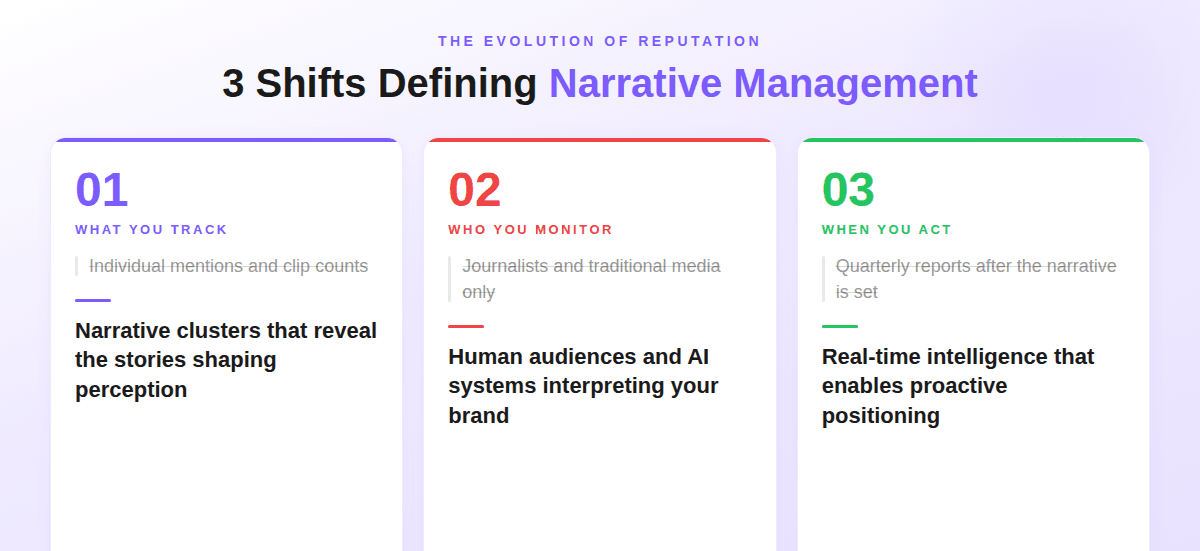
Most communications teams are familiar with media monitoring: tracking where and when a brand gets mentioned, logging clip counts, and compiling quarterly reports. Narrative management operates at an entirely different level. Instead of asking "where were we mentioned?" it asks "what story is forming about us—and who controls it?"
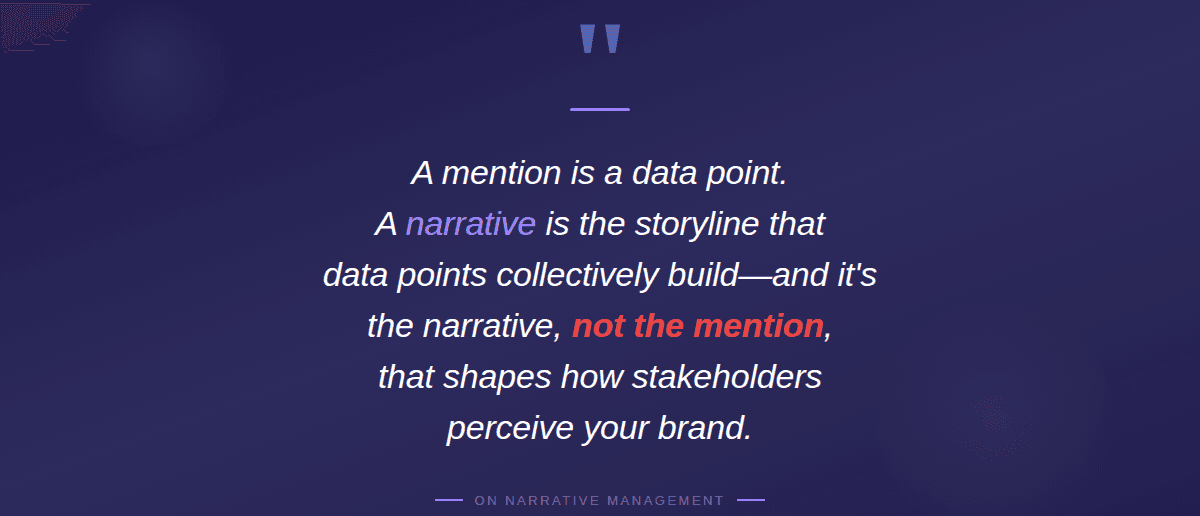
This distinction matters because reputation doesn't live in individual articles or social posts. It lives in the patterns those articles and posts create when viewed together. Twenty articles sharing a similar angle about your leadership, your product quality, or your company culture? That's a narrative—and it's the narrative, not the individual mention, that shapes how stakeholders perceive your brand.
The Narrative vs. The Mention
Think of it this way: a mention is a data point. A narrative is the storyline that data points collectively build. Traditional monitoring captures the data points. Strategic narrative intelligence reveals the storylines—and gives teams the insight they need to influence them before they calcify into settled perception.
This is especially urgent now because the information environment has fundamentally changed. Coverage cycles move faster, social amplification is instant, and AI systems are now consuming and redistributing brand storylines at scale. Managing those storylines proactively has become a business imperative, not a communications nice-to-have.
How Has AI Changed Brand Reputation Monitoring?
AI hasn't just accelerated how fast information travels. It's created an entirely new audience for your brand.
Large language models like ChatGPT, Gemini, and Claude now serve as information intermediaries for millions of users. When these systems answer questions about a company, they synthesize available coverage into a consolidated narrative. A recent analysis from Marketing Dive detailed how the Campbell's Soup controversy didn't just play out across traditional media—the negative storyline was quickly reinforced across AI platforms and search engines, extending its reach far beyond the original news cycle.
This represents a seismic shift for brand reputation monitoring. In the legacy model, a negative story eventually fades from headlines. In the AI-mediated model, a negative narrative can become embedded in how machines describe your brand for months—or longer.
Why LLMs Make Proactive Reputation Strategies Essential
For communications leaders, this introduces a new layer of accountability. It's no longer enough to manage how journalists cover your brand. You need to understand—and influence—how AI systems interpret and present your brand's story. That requires moving beyond corporate reputation monitoring built on keyword tracking and into systems that analyze narrative formation, sentiment direction, and the storylines gaining traction across both human and machine audiences.
The practical implication: brands that actively shape their narrative landscape are far more likely to appear accurately in AI-generated responses. Those that don't risk having outdated or competitor-favorable storylines define their AI presence by default.

What Does Proactive Narrative Shaping Look Like in Practice?
Reactive communications follows a familiar pattern: something happens, the team mobilizes, messages are crafted, and the brand tries to steer the conversation back toward favorable territory. A proactive approach flips that sequence—monitoring the formation of storylines in real time and intervening strategically before they reach mainstream attention.
Continuous Narrative Surveillance
Rather than relying on periodic reports, teams track narrative clusters and storylines—groups of related articles and coverage that together form a coherent story. This reveals emerging themes long before they become headlines, giving teams the window to respond strategically rather than reactively.
Brand-Centric Sentiment Analysis
Traditional sentiment tools classify coverage as positive, negative, or neutral. But a positive article about your industry isn't the same as a positive article about your brand. Effective narrative management requires sentiment analysis calibrated specifically to your brand—understanding whether coverage positions you favorably, whether you're the focus or a passing mention, and whether the publication carries meaningful authority with your stakeholders.
Competitive Narrative Benchmarking
Reputation doesn't exist in a vacuum. Your narrative position is always relative to competitors. A strong corporate reputation monitoring practice includes tracking how competitors are covered within the same storylines, where they're gaining favorable positioning, and where your team can fill gaps with strategic communications.
Reactive Approach | Proactive Narrative Approach |
Monitors brand mentions after publication | Tracks narrative formation in real time |
Measures clip counts and media volume | Analyzes storyline momentum and sentiment direction |
Reports quarterly on past coverage | Delivers continuous intelligence for immediate action |
Treats all coverage equally | Weights coverage by publication authority and brand prominence |
Responds to crises after they escalate | Identifies emerging risks before they become crises |
Five Pillars of an Effective Narrative Strategy
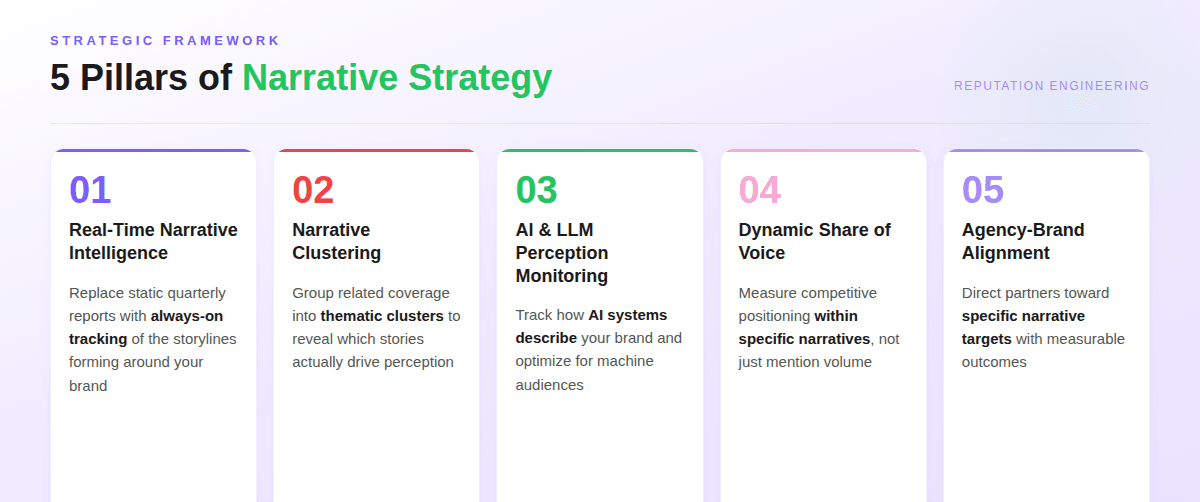
Building a narrative management capability requires a clear framework. Here are the five foundational elements enterprise communications teams should prioritize:
1. Real-Time Narrative Intelligence Replace static reporting with always-on narrative tracking. The organizations gaining a competitive edge are the ones that treat reputation as a living system, measuring narrative movement rather than media volume.
2. Narrative Clustering Individual articles rarely tell the full story. Grouping related coverage into thematic clusters reveals which storylines are driving perception and how those themes evolve over time. This is the difference between tracking a hundred scattered mentions and understanding the three storylines that actually define your reputation.
3. AI and LLM Perception Monitoring Understanding how AI systems describe your brand is now a core communications function. This means tracking your brand's presence in LLM-generated responses, monitoring for inaccuracies or outdated storylines, and optimizing content to influence how machines interpret your story.
4. Dynamic Share of Voice Static share of voice metrics—simple mention ratios against competitors—don't capture the full picture. Dynamic share of voice reveals where you're winning and losing within specific narratives, giving communications leaders a clear view of competitive positioning as the coverage landscape evolves.
5. Agency-Brand Alignment When communications teams have real-time narrative intelligence, they can work more effectively with external partners—sharing specific narrative targets rather than broad mandates and measuring impact against narrative-level outcomes.
How Can Brands Prevent Crises Through Better Intelligence?
The most expensive crisis is the one you didn't see coming. And in most cases, the signals were there—just buried in noise or visible only at the narrative level.
PRSA recently highlighted that AI now offers a game-changing opportunity for crisis prevention, noting that beyond accelerating response times, AI can help organizations build immunity to crises by identifying weak signals early and enabling smarter, more proactive communications.
Early Warning Through Narrative Shifts
Consider a scenario where a handful of industry publications begin framing your company's sustainability commitments as performative. Individually, each article might not trigger alarm bells. But when real-time narrative intelligence reveals these articles clustering into a coherent "greenwashing" storyline—with increasing publication authority and growing social amplification—the early warning is unmistakable. The communications team can address the storyline directly, amplify counter-narratives with substantive evidence, and brief leadership before the story reaches mainstream outlets.

From Damage Control to Strategic Positioning
The traditional crisis playbook focuses on containment: minimize damage, control the message, wait for the cycle to pass. Proactive narrative intelligence makes a fundamentally different promise—intervening earlier, with more precision, and with a strategy designed to strengthen your reputation rather than just limit harm. This represents a broader shift in reputation management for PR—from a defensive function into a strategic asset that gets engineered intentionally.
What Should a Modern Narrative Framework Include?
Enterprise communications leaders evaluating their readiness should audit capabilities across several dimensions:
Capability | Legacy Approach | Modern Approach |
Data Collection | Boolean-based monitoring, manual filtering | AI-driven narrative discovery and enrichment |
Analysis | Quarterly reports with clip counts | Real-time narrative clustering and sentiment tracking |
Audience Scope | Human media only | Human media + LLM/AI perception monitoring |
Competitive Intelligence | Basic mention volume comparison | Narrative-level competitive positioning |
Crisis Readiness | Post-event response protocols | Pre-crisis surveillance and early warning |
Executive Reporting | Volume-based dashboards | Strategic intelligence tied to business impact |
The organizations making this transition most successfully recognize that this strategic function belongs at the executive level. When the VP of Communications can walk into a board meeting and explain exactly which storylines are defining the brand, how those compare to competitors, and what the team is doing to influence them, that's a fundamentally different conversation than presenting a clip count summary.
Frequently Asked Questions
How is narrative management different from traditional media monitoring? Media monitoring tracks individual mentions—where your brand appeared, in which outlet, and when. Narrative-level strategy goes further by clustering related coverage into storylines, analyzing how those storylines shape perception, and providing intelligence that enables proactive response rather than reactive reporting.
Why do AI and LLMs make this approach more urgent? Large language models synthesize brand coverage into consolidated narratives that millions of users encounter. Unlike traditional media, where negative stories eventually cycle out, AI systems can embed and repeat unfavorable storylines for extended periods. Proactive management ensures that what AI surfaces about your brand is accurate, current, and favorable.
Can this approach actually prevent crises? While no system prevents all crises, tracking narrative formation significantly improves early detection. Communications teams can identify emerging reputational risks—such as negative sentiment clustering around a specific theme—and intervene before the story reaches mainstream coverage or becomes embedded in AI-generated responses.
What role does competitive intelligence play? Reputation is always relative. Your brand's position exists in context with competitors. Tracking how competitors are positioned within shared storylines reveals where they're gaining favorable coverage and where opportunities exist for your brand to lead the conversation.
Start Engineering Your Reputation—Before Someone Else Does
The shift from reactive monitoring to proactive narrative strategy isn't a technology upgrade. It's a strategic evolution in how communications leaders protect and grow brand value. The brands thriving today see the stories forming, understand the forces driving them, and act with confidence before those stories become settled perception—across both human audiences and AI systems.
If your team is ready to move from counting mentions to engineering reputation, Handraise provides the narrative intelligence platform built for exactly this moment. Book a demo and see how real-time narrative intelligence changes the way your brand leads.
Matt Allison
Founder & CEO
Share