Blog
Insights
Straightforward interfaces make navigation and actions more intuitive, reducing the learning curve for new users.

Matt Allison
Founder & CEO

Key Takeaways
Executive leaders want outcomes, not outputs—and the right PR analytics bridge that gap.
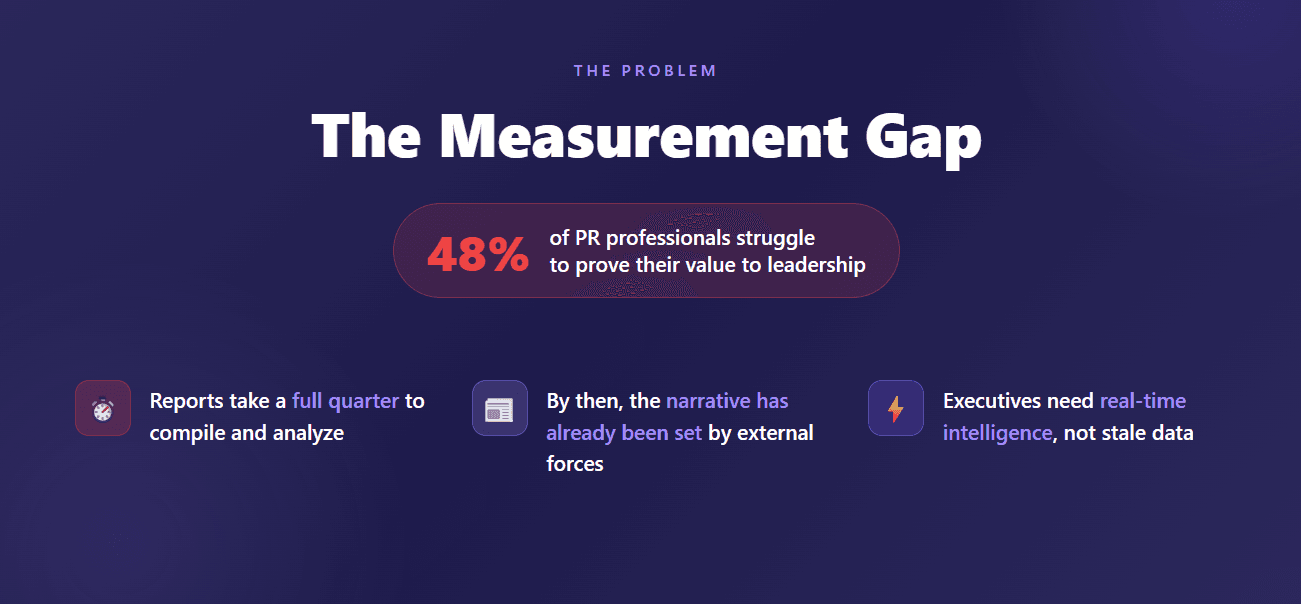
Nearly half of PR professionals struggle to prove the value of their work, creating urgency for better measurement approaches
C-suite executives care about metrics that connect to business results: brand reputation, competitive positioning, and risk detection—not clip counts
Real-time narrative intelligence and brand-centric sentiment have emerged as the new standard for strategic communications measurement
Moving beyond vanity metrics to outcome-focused analytics is no longer optional—it's the price of admission to executive conversations
If your PR reports still lead with impressions, you're speaking a language your leadership has stopped listening to.
Communications leaders face an uncomfortable truth: proving value to the C-suite requires speaking a language that resonates in the boardroom. Research from AMEC indicates that 75% of communicators believe PR must align with business results to earn strategic influence—yet bridging that gap remains elusive for many teams. The disconnect between what communications intelligence teams measure and what executives actually care about has never been more pronounced.
While PR professionals track media impressions, share of voice, and sentiment scores, the C-suite asks pointed questions: How did this campaign affect our brand's competitive position? What narratives are forming that could impact our stock price? Are we winning or losing the stories that matter?
This gap represents both a crisis and an opportunity. Communications teams that master the PR analytics executive leaders actually value will earn budget, influence, and strategic authority. Those who continue delivering vanity metrics will find themselves increasingly marginalized in strategic conversations.
Why Do Traditional PR Measurement Fall Short for Executives?
The fundamental problem with legacy PR measurement isn't that it tracks the wrong things—it's that it tracks things that don't translate into strategic insight. Media impressions tell you how many eyeballs might have seen coverage. They don't tell you whether that coverage moved the needle on reputation, positioned the brand against competitors, or surfaced risks requiring executive attention.
According to industry research compiled by Britopian, 48% of PR professionals struggle to prove the value of their work—a figure that's risen from 41% just two years prior. This measurement gap creates a credibility problem: when communications teams can't prove their value in terms executives understand, budgets get scrutinized and strategic influence erodes.
The C-suite operates in a world of P&L responsibility, market share battles, and shareholder expectations. When communications teams arrive with reports about "total potential reach" and "advertising value equivalency," the disconnect is jarring—and damaging.
The Shift from Outputs to Outcomes
Successful communications leaders have recognized that executive audiences require a fundamentally different approach. Rather than asking "what did we do?" these leaders ask "what changed because of what we did?"
This shift requires moving beyond counting activities (press releases distributed, media placements secured) toward tracking effects (narrative shifts, competitive positioning changes, risk emergence). It's the difference between telling executives you secured 47 placements last quarter and showing them that favorable coverage of your sustainability initiatives now outpaces your largest competitor by 3:1.
How Should PR Teams Measure Impact Beyond Impressions?
Executive leaders don't wake up thinking about impressions and reach. They think about competitive threats, market opportunities, and reputational risks. The PR analytics that matter to them reflect these priorities.
Modern media analytics must answer these questions with clarity. This means moving beyond single-dimensional metrics toward multidimensional intelligence that captures the complexity of how reputation actually forms.
The Seven Analytics That Earn Executive Attention
Based on research into executive priorities, seven categories of PR analytics consistently demonstrate value at the C-suite level:
1. Narrative Intelligence and Clustering
Executives care about the stories forming around their brand, not individual articles. Narrative clustering technology groups related coverage into coherent storylines, revealing which themes are gaining momentum and how they're shaping broader perception.
2. Brand-Centric Sentiment Analysis
Traditional sentiment analysis treats all coverage equally. Brand-centric sentiment recognizes that an article might be positive about the industry while being negative about your company—or vice versa.

3. Dynamic Share of Voice
Legacy share of voice metrics simply count mentions against competitors. Dynamic share of voice weights coverage by publication authority, audience relevance, and narrative prominence—telling executives whether they're winning the conversations that actually matter.
4. Reputation Impact Scoring
Combining sentiment, prominence, publication authority, and reach into a single impact score allows executives to track reputation trajectory over time and benchmark against competitors.
5. Risk and Crisis Indicators
Advanced PR analytics identify early warning signals—sudden shifts in narrative direction or emerging themes that could spiral into reputation threats. A 2024 study from Ragan Communications and HarrisX, featured by the Institute for Public Relations, found that 76% of communications leaders at medium and large organizations view brand safety—protecting the company from harmful associations that could hurt its reputation—as a necessity.
6. LLM and AI Perception Tracking
As AI systems increasingly shape how people discover information about brands, executives need visibility into how these systems perceive their companies. This emerging category tracks what AI says when asked about your brand and whether your narrative engineering efforts are influencing machine perception.
7. Publication Tiering and Authority Weighting
Not all coverage is created equal. Publication tiering analytics weight coverage by outlet authority, enabling executives to understand not just coverage volume but coverage quality.
What PR Reporting Formats Do C-Suite Executives Prefer?
Even the best analytics fail if they're not communicated effectively. Executive audiences have specific preferences for how information should be packaged.
Executive Preference | What It Means for PR Teams |
Visual dashboards over text-heavy reports | Lead with charts and graphs that show trends at a glance |
Comparative context | Always benchmark against competitors and historical performance |
Forward-looking insights | Indicate what findings mean for future action |
Business language | Frame metrics in terms of risk, opportunity, and competitive advantage |
Executive summaries | Put key findings first; detailed data can follow |
The format of your PR reporting tools matters almost as much as the content. Executives scan dashboards; they don't read twenty-page reports.
Real-Time Intelligence Versus Quarterly Retrospectives
One significant shift involves timing. The quarterly report model no longer satisfies executives who monitor business metrics in real time. Modern PR measurement platforms deliver continuous intelligence rather than periodic snapshots.
This matters because narratives move quickly: a story that begins forming on Monday could become a crisis by Friday. Executives who learn about emerging narratives in real time can take action; those who learn about them in quarterly reports can only conduct post-mortems.

How Can PR Measurement Connect to Business Outcomes?
The holy grail of PR analytics—and the key to sustained executive support—is demonstrating connection to business outcomes. This doesn't mean every piece of coverage needs direct revenue attribution. It means PR analytics should contribute to a coherent story about how communications affects the metrics executives care about.
Several approaches help establish this connection:
Correlational analysis tracks whether improvements in reputation metrics correspond with movements in business metrics over time. If positive narrative shifts consistently precede improvements in brand consideration, that pattern strengthens the case for communications investment.
Attribution frameworks borrowed from marketing can track specific campaign impacts. When PR activities drive website traffic that converts into leads, proper tracking captures that contribution.
Qualitative feedback from sales, investor relations, and recruiting teams provides supporting evidence. When salespeople report that prospects cite favorable coverage as a factor in decisions, these testimonials complement quantitative metrics.
Executive Question | Dashboard Element |
"How is our reputation trending?" | Reputation impact score with competitor comparison |
"What narratives are shaping perception?" | Top narrative clusters ranked by impact |
"Where are we winning and losing?" | Dynamic share of voice by narrative category |
"What should concern me?" | Emerging risk indicators and alerts |
"What's our AI presence?" | LLM perception summary across platforms |
Frequently Asked Questions About PR Analytics
What's the single most important PR metric for C-suite executives?
Reputation impact score—a composite metric combining sentiment, prominence, and authority—consistently resonates because it answers: "Overall, are things getting better or worse for our brand?"
How often should PR teams report analytics to executive leadership?
The trend moves toward continuous availability rather than periodic reporting. Executives should have access to real-time dashboards, supplemented by weekly briefings highlighting significant changes.
How can communications teams demonstrate ROI when PR doesn't directly generate revenue?
Focus on correlation rather than direct attribution. Track whether improvements in PR metrics correspond with improvements in business metrics over time. Capture qualitative evidence: testimonials from sales teams about coverage influencing deals, recruiter feedback about reputation attracting candidates.
What's the best way to get executive buy-in for PR analytics tools?
Frame the investment in terms executives understand: competitive advantage, risk reduction, and efficiency. Show how competitors are using advanced analytics for visibility you currently lack. Present a pilot proposal that delivers quick wins before requesting full investment.
Transform Your PR Analytics Into Executive Intelligence
The gap between what communications teams measure and what executives value represents both challenge and opportunity. Teams that bridge this gap with analytics focused on outcomes rather than outputs, narratives rather than mentions, and real-time intelligence rather than quarterly retrospectives will earn strategic influence.
For communications leaders ready to elevate their analytics from activity reports to executive intelligence, Handraise delivers the narrative intelligence, brand-centric sentiment analysis, and real-time visibility that transforms how executives understand PR performance. Book a demo to see how your team can speak the language executives actually want to hear.
Matt Allison
Founder & CEO
Share