
Media intelligence elevates PR from reactive tracking to strategic foresight—transforming scattered mentions into the narrative insights that actually shape reputation.
Key takeaways
- Raw monitoring captures data; intelligence reveals meaning. The difference determines whether your team reacts to headlines or shapes the stories that define your brand.
- AI-powered analysis now processes sentiment, trends, and competitive positioning faster than any manual workflow could achieve. Two-thirds of communicators now use AI frequently in their work, with 70% reporting it improves quality and 73% saying it helps them work more quickly.
- Decision-makers need context, not clip counts. A robust intelligence platform surfaces the "so what" and "now what" behind every mention.
- The organizations outpacing competitors treat reputation as a living system—measuring narrative movement, not just media volume.
If your current approach stops at tracking mentions, it's time to ask whether you're measuring what actually matters.
Why Are PR Teams Moving Beyond Basic Monitoring to Media Intelligence?
Communications professionals have always needed to understand what people are saying about their brands. But knowing what is being said and understanding what it means are fundamentally different things.
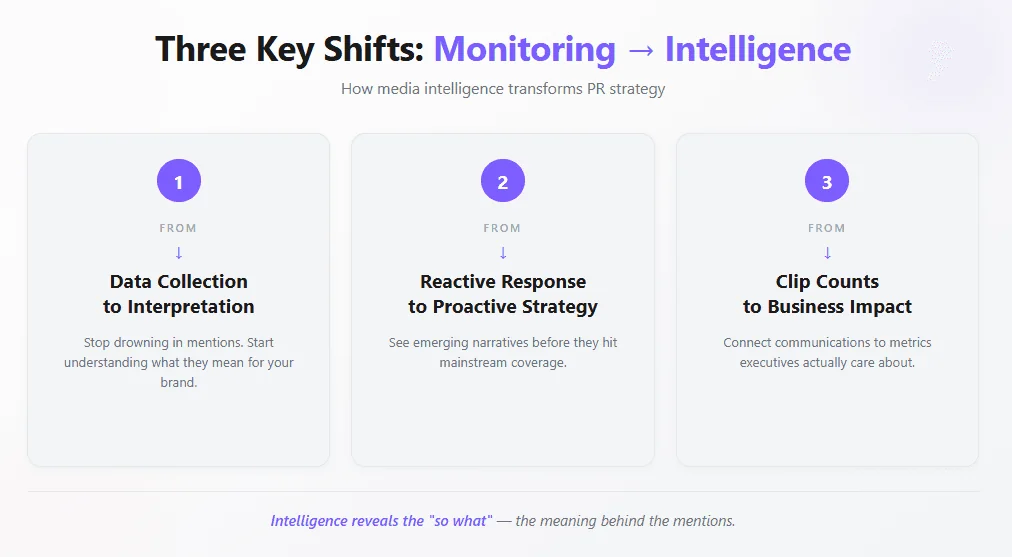
Basic media monitoring serves an important function—it aggregates mentions across print, broadcast, digital, and social channels so you can see where your brand appears. However, visibility without interpretation creates more noise than clarity. When PR teams receive thousands of mentions each week, the real question shifts from "how many?" to "so what?"
This is where media intelligence steps in. Rather than simply collecting data, this approach transforms that data into strategic insight. It connects the dots between individual mentions and broader narrative patterns. It surfaces sentiment shifts before they become crises. It benchmarks your share of voice against competitors in ways that reveal positioning, not just volume.
The transition from monitoring to intelligence represents a fundamental shift in how communications teams operate. Traditional approaches often take an entire quarter to compile and analyze—by which point the narrative has already been set by external forces and the report sits ignored. Intelligence eliminates that lag, letting teams focus on interpretation and action in real time.
What Is Media Intelligence and How Does It Differ from Monitoring?
Understanding the distinction between monitoring and intelligence clarifies why the latter has become essential for modern PR strategy.
The Monitoring Layer: Collecting the Raw Material
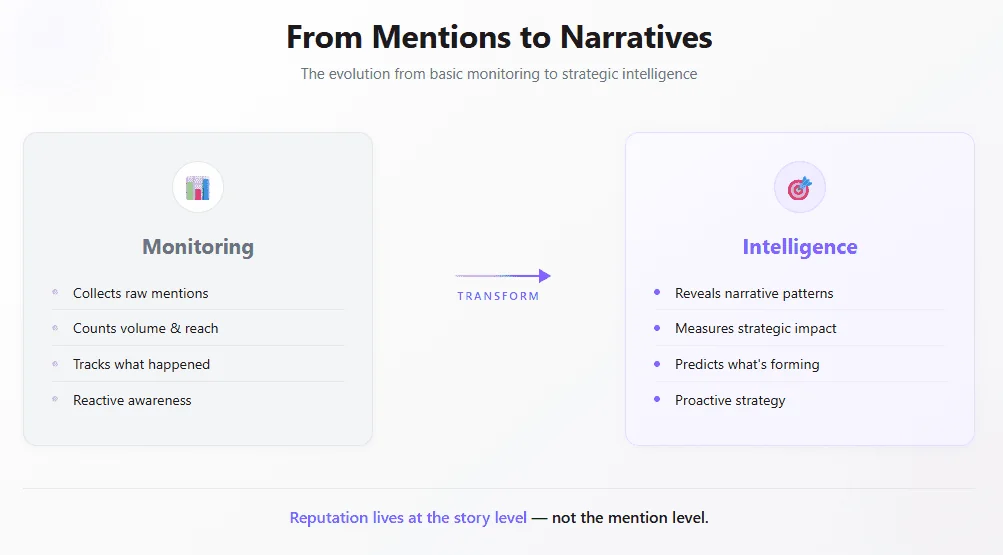
Media monitoring handles the foundational work of data collection. It scans thousands of sources—news outlets, trade publications, blogs, podcasts, forums, and social platforms—to capture every mention of your brand, competitors, and relevant keywords.
This layer answers surface-level questions: Where did our brand appear today? Which outlets covered our announcement? What volume of mentions occurred this week?
These questions matter, but they stop short of strategic value. Legacy tools built on Boolean queries and keyword matching tell you that something happened without revealing why it matters or what to do about it.
The Intelligence Layer: Extracting Strategic Meaning
Advanced PR intelligence tools take that raw material and apply analytical frameworks to extract meaning. This involves sentiment analysis that goes beyond simple positive-negative-neutral classifications to understand brand-specific context—whether a mention is a headline feature or a passing reference, and whether the source carries high domain authority or limited reach. It includes trend detection that identifies patterns across time. Most importantly, it surfaces the narrative themes clustering around your brand and reveals how those themes compare to competitors.
The intelligence layer answers different questions: What story is forming around our brand? How does coverage tone affect reputation with specific audiences? Which narratives are gaining momentum? Where do opportunities or risks exist that require action?
When PR teams shift from monitoring to intelligence, they shift from documentation to decision-making.
| Capability | Media Monitoring | Media Intelligence |
|---|---|---|
| Primary Function | Data collection and aggregation | Analysis and interpretation |
| Output | Volume metrics and mention lists | Strategic insights and recommendations |
| Time Orientation | What happened | What it means and what comes next |
| Decision Value | Reactive awareness | Proactive strategy guidance |
| Typical Users | Tactical execution teams | Strategic communications leadership |
How Does a Media Intelligence Platform Strengthen Decision-Making?
The value of intelligence over monitoring becomes clearest when examining how communications leaders actually make decisions.
Moving from Reactive to Proactive Strategy
Without intelligence, PR teams operate in reactive mode—responding to coverage after it appears, addressing crises after they escalate, and reporting on campaigns after results are fixed.
A robust intelligence platform enables proactive positioning. By identifying emerging narratives before they reach mainstream coverage, teams can shape stories rather than respond to them. By tracking sentiment patterns and narrative clusters over time, they can anticipate stakeholder reactions and prepare appropriate responses. This shift transforms the communications function from support role to strategic driver.
Connecting PR Metrics to Business Outcomes
Executive leadership rarely cares about clip counts. They want to understand how communications activities affect brand perception, customer behavior, and business results.
This intelligence approach bridges that gap by providing metrics that map to business value. Rather than reporting that your brand received 500 mentions, intelligence reveals how those mentions contributed to a specific narrative position relative to competitors. It connects earned media activity to measurable shifts in brand-centric sentiment that affect reputation over time. When PR leaders can present this kind of analysis, they earn—and retain—seats at strategic tables.
Enabling Faster, More Confident Crisis Response
Crisis situations demand rapid assessment and action. Monitoring alone provides a flood of mentions without context. Strategic intelligence provides prioritized signals—which narratives pose reputational risk, which sources carry influence, and which response strategies are most likely to succeed.
The speed advantage alone justifies the investment. Research from Axios indicates that nine in ten PR professionals say AI-powered tools help them work faster, with roughly eight in ten reporting improved work quality. During crisis moments, that efficiency can mean the difference between containment and escalation.
What Are the Top Ways PR Intelligence Transforms Communications?
The practical applications of this intelligence approach span the full communications workflow. Here are five key areas where it drives measurable improvement.
1. Campaign Planning and Message Development
Before launching a campaign, intelligence reveals the current narrative landscape around your topic. It identifies what themes resonate, which messages fall flat, and where gaps exist that your brand can own. This contextual foundation leads to campaigns designed for impact rather than hope.
2. Competitive Positioning and Benchmarking
Understanding your dynamic share of voice requires more than counting mentions. Intelligence analyzes how your brand's narrative position compares to competitors across key themes. It reveals whether you're leading conversations or following them—and identifies specific opportunities to shift that balance.
3. Stakeholder and Audience Insights
Different audiences interpret the same coverage differently. Modern intelligence tools can segment analysis by audience type, revealing how coverage lands with investors versus customers versus employees. This segmentation enables communications tailored to each stakeholder group.
4. Executive Reporting and Board Communications
Leadership needs clarity, not complexity. Intelligence platforms generate executive-ready insights that summarize what matters without drowning recipients in data. The ability to distill thousands of mentions into a narrative summary with clear implications represents significant value for communications leaders who report to C-suite executives.
5. Risk Identification and Early Warning
Perhaps most valuable is the ability to spot emerging risks before they escalate. By tracking narrative shifts and sentiment changes across channels, intelligence surfaces warning signals that manual monitoring would miss. Early identification creates time for strategic response.

What Should You Look for in Media Intelligence Tools?
The market offers numerous options for PR teams seeking intelligence capabilities. Not all platforms deliver equal value. When evaluating these tools, prioritize capabilities that align with strategic needs.
Analysis Depth Over Data Volume
Some platforms compete on source coverage—how many outlets they monitor. While comprehensive coverage matters, analysis depth matters more. Look for tools that move beyond surface-level sentiment to understand context, framing, and narrative positioning.
Integration and Customization
Evaluate how platforms integrate with existing workflows—CRM systems, reporting tools, collaboration platforms. The best intelligence surfaces in the right context at the right time. Additionally, platforms that allow customization for your brand's unique context deliver more accurate and actionable intelligence than generic sentiment analysis.
Forward-Looking Capabilities
Historical reporting has its place, but strategic value comes from anticipation. Look for platforms that identify emerging narratives, predict trend trajectories, and surface opportunities before competitors see them.
| Evaluation Criteria | Why It Matters | Questions to Ask |
|---|---|---|
| Analysis Depth | Surface metrics miss strategic context | Does the platform explain why sentiment shifted, not just that it did? |
| Workflow Integration | Insights must reach decision-makers | How do alerts and reports integrate with tools teams already use? |
| Brand Customization | Generic analysis misreads specific contexts | Can we train the system on our brand's unique positioning? |
| Predictive Capability | Anticipation beats reaction | Does the platform identify emerging narratives before they peak? |
| Narrative Clustering | Stories matter more than mentions | Can we see how individual mentions connect to larger themes? |
What Role Does AI Play in Modern PR Intelligence?
Artificial intelligence has become central to these intelligence capabilities. The volume and velocity of media content make manual analysis impossible at scale. AI enables the pattern recognition, sentiment analysis, and trend detection that define strategic value.
Processing Speed and Sophisticated Analysis
AI systems can analyze thousands of articles, posts, and mentions in seconds—work that would take human analysts days or weeks. This speed enables real-time awareness and rapid response when situations evolve quickly. Modern AI applies natural language processing that understands context, sarcasm, and brand-specific meaning—a dramatic improvement over early keyword-matching tools that frequently misclassified nuanced content.
Pattern Recognition and Human Partnership
Human analysts struggle to identify patterns across disparate sources—a comment here, an article there, a social post elsewhere. AI excels at connecting these dots, revealing narrative themes that emerge across the media landscape. Yet despite AI's capabilities, human judgment remains essential. AI identifies patterns; humans interpret meaning. AI surfaces signals; humans determine responses.
According to industry data, AI enables PR professionals to focus their efforts on strategic responses rather than data collection—transforming the role from information gatherer to strategic advisor.
Frequently asked questions
Most organizations see immediate value in the shift from raw mention tracking to analyzed intelligence. Teams often reclaim hours weekly that can redirect toward strategic work. Deeper value emerges over time as teams build on historical intelligence to identify patterns and anticipate trends.
Intelligence platforms augment human capability rather than replace it. They handle data processing and pattern recognition that would overwhelm human capacity. However, strategic interpretation—determining what insights mean for your brand and what actions to take—remains a human function.
Traditional sentiment analysis classifies individual mentions as positive, negative, or neutral. Narrative intelligence examines how mentions connect to larger stories forming around your brand—revealing the themes and storylines shaping perception. This distinction matters because reputation lives at the story level, not the mention level.
Forward-looking intelligence platforms analyze how brands appear in AI-generated content, not just traditional media. This includes tracking how large language models characterize brands and identifying gaps between media coverage and machine interpretation. The best platforms go further—helping brands optimize their narratives so that when anyone asks an AI a question, the brand appears in the best possible light. As AI systems become primary information sources, understanding and influencing this dimension becomes critical to reputation management in the age of AI.
Engineer Your Reputation with Intelligence That Matches Today's Challenges
The communications profession has always been about shaping how audiences perceive organizations. What has changed is the complexity—more channels, faster information flow, and AI systems that synthesize and amplify narratives at unprecedented scale.
Monitoring tells you what happened yesterday. Intelligence reveals what's forming today and where tomorrow's opportunities and risks exist.
Handraise delivers the narrative intelligence modern communications teams need—transforming scattered signals into strategic clarity. If you're ready to move beyond mention counting toward genuine reputation engineering, book a demo to see how intelligence changes everything.