
Key takeaways
- The best PR measurement software turns coverage into decisions your leadership can trust, and a feature list is the least reliable way to find it.
- Data quality comes first because no amount of AI fixes a feed full of syndicated duplicates and passing mentions.
- Analytics depth means brand-centric sentiment and narrative-level analysis, plus share of voice you can filter by what matters.
- AI systems now describe your company to stakeholders, so perception measurement belongs in the same platform as media measurement.
- Enterprise fit comes down to governance and how much manual work the platform removes.
- Test every shortlisted platform on one of your real narratives, using your own data, before you sign anything.
Every PR software demo shows clean charts, and every vendor calls its analytics AI-powered. Knowing which option will be useful the morning your CEO asks why a story is spreading is the challenge.
That AI label deserves the most skepticism. In Salesforce's State of Data and Analytics research, 89% of data and analytics leaders with AI in production said they'd experienced inaccurate or misleading AI outputs. For a communications team, a confident summary built on bad data can send leadership the wrong way on a story that's still moving.
Communications leaders comparing the best PR measurement software for an enterprise team need a way to see past the demo. If you're still deciding what to measure, start with our Guide to Modern PR Measurement. Below are the criteria that separate platforms and the questions that expose gaps, plus a look at what modern communications intelligence platforms do that older reporting tools can't.
What Makes the Best PR Measurement Software?
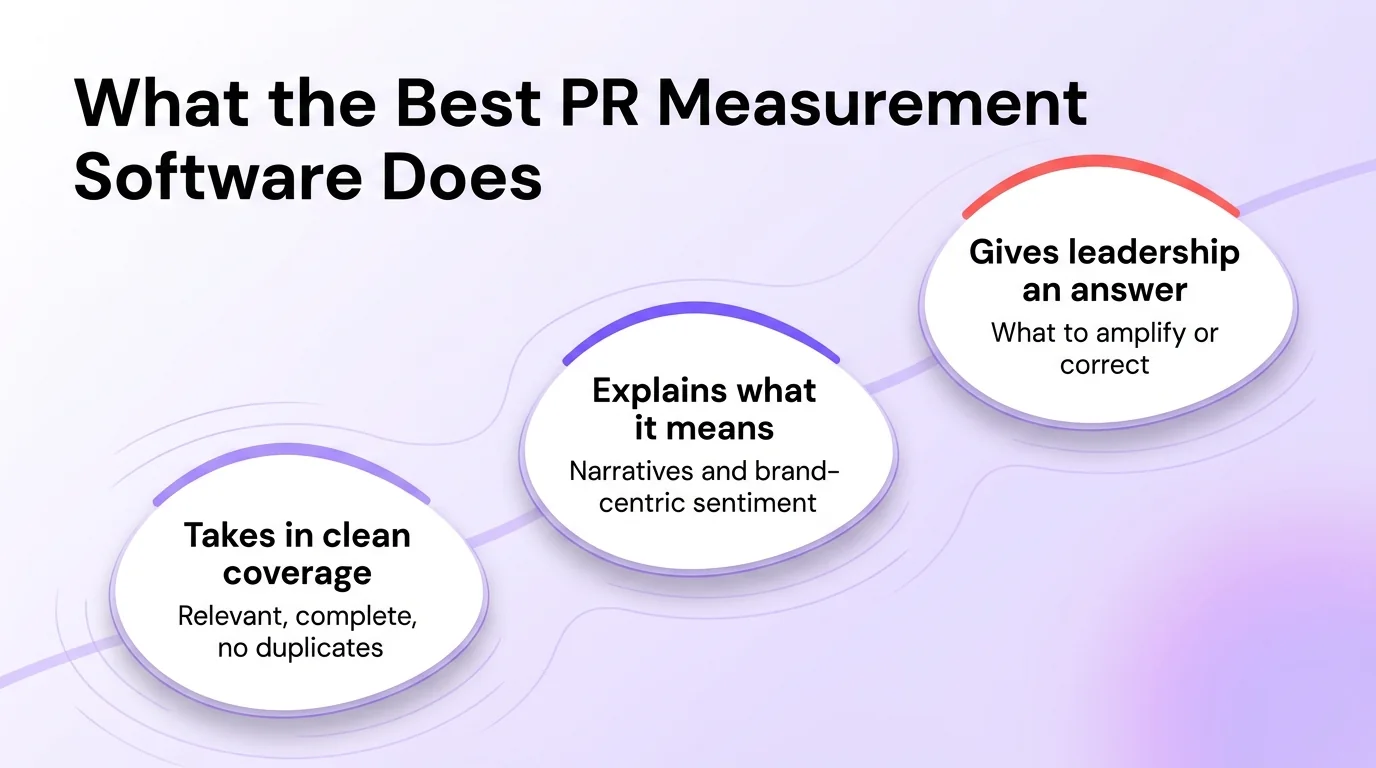
The strongest platforms take in clean, complete coverage, explain what it means for your reputation, and give leadership an answer it can act on. The charts help your analysts. Leadership needs a decision about what to amplify or correct.
Most PR measurement software falls into one of three groups. They overlap, so judge each by its output rather than its category name.
| Category | What it does well | Where it stops | Best fit |
|---|---|---|---|
| PR reporting tools | Collect coverage, count mentions, estimate reach, and build scheduled reports | Describes activity, and your team still works out what it means | Teams that mainly need proof of coverage |
| PR analytics platform | Adds sentiment, share of voice, publication tiering, and competitor comparisons | Analysis stays article by article, so dashboards still need an analyst | Teams with in-house analysts and steady reporting needs |
| Communications intelligence platform | Groups coverage into narratives, measures brand-centric sentiment and AI perception, and produces briefings | Needs setup around your priorities, competitors, and outlets | Enterprise teams that need answers while a story is still moving |
Basic PR reporting tools reliably answer "did we get coverage?", then stop short of the question executives ask, which is what that coverage is doing to how people see the company.
Does the Platform Start With Clean, Complete Data?
A PR measurement platform has to start with clean data because syndicated copies counted as separate wins will inflate your share of voice before anyone opens a dashboard. The same Salesforce research found data leaders estimate that 26% of their organization's data is untrustworthy. There's little reason to think media data is cleaner.
Coverage that matches where your stakeholders read
Ask which sources the vendor licenses, including paywalled outlets, trade titles, broadcast, and podcasts. Raw source counts don't tell you much. What matters is whether the platform reliably captures the publications your investors and regulators read. Our guide to Media Monitoring Tools and Software covers this foundation in more depth.
Relevance filtering without Boolean babysitting
Ask how the platform tells an article about you from one that mentions you in passing, and how it treats syndicated duplicates. If getting there means your team maintains long Boolean strings and exclusion lists that need updating every time a competitor launches a product or a new executive starts talking to reporters, add that labor to the price. Context-aware relevance is a core feature of the best PR measurement software, and it frees analysts to spend their hours judging coverage.
How Deep Should PR Analytics Software Go?
Analytics should go deep enough to tell you whether a negative-sounding story helped your brand. Plenty of tools can draw a sentiment pie chart. Far fewer can make that call, and the gap shows up fast in a side-by-side demo.
Brand-centric sentiment
Let's say an article about a weakening economy quotes your CEO as the steady expert. Article-level sentiment scores it as negative. Brand-centric sentiment looks at how your company comes across inside the story, and here that's favorable. During the demo, hand each vendor a few mixed articles like this one and check whether its classifications would match how your own team scored them.
Narrative-level analysis
Reputation forms around stories, and each story is built from dozens or hundreds of articles. A PR analytics platform that clusters related coverage into narratives shows which storylines are growing and who's driving them. It also shows where you sit in each one. If a platform can only list articles, your analysts become the clustering engine.
Filterable share of voice
A single share of voice percentage hides almost everything that matters. You want Dynamic Share of Voice that recalculates by publication tier, headline presence, sentiment, message, and narrative, so you can see who's winning the coverage leadership reads. Message pull-through belongs here too. The platform should catch reporters carrying your idea in their own words. For more, see Metrics Beyond Share of Voice.
Can It Measure AI Perception Alongside Media?
A modern platform should measure AI perception alongside media because AI assistants read the same coverage your stakeholders do and summarize it for anyone who asks. According to Eurostat's EU generative AI usage data, 32.7% of people aged 16 to 74 in the EU used generative AI tools in 2025, and 15.1% used them for work. That makes AI systems a stakeholder audience, repeating your earned media to people who may never read the original.
So look at how a platform measures that audience. Some tools count brand appearances across a fixed list of prompts, a useful sample that covers only the questions someone thought to write down. Stronger PR analytics software starts from your priority narratives and shows how AI systems describe them, which claims they repeat, and which sources they cite. Our guide on How to Measure AI Brand Perception covers the methodology.
Listen for one honest caveat in every demo. Measurement shows you what AI systems say and why, but no platform can edit their answers. A vendor who promises otherwise is overselling.
Will Leadership Actually Use What the Platform Produces?
Leadership uses a platform when its output arrives as answers, and most PR reporting tools stop at the dashboard. That model works for the analyst and leaves the CEO waiting for an explanation.
Dashboard flexibility for the team
Your team needs to slice coverage by business unit or narrative and save those views without filing a support ticket. Check that filters apply consistently across every metric, so Tier 1 sentiment and Tier 1 share of voice come from the same coverage. Exports should be clean enough to share without rework.
Executive briefings for leadership
Senior leaders want to know what changed, why it matters, and what to do next, in a page or less. Ask to see automated briefings that answer those questions, with every claim linked to the coverage behind it. The AI Executive Briefing walks through what that format looks like in practice.
Automation that removes work
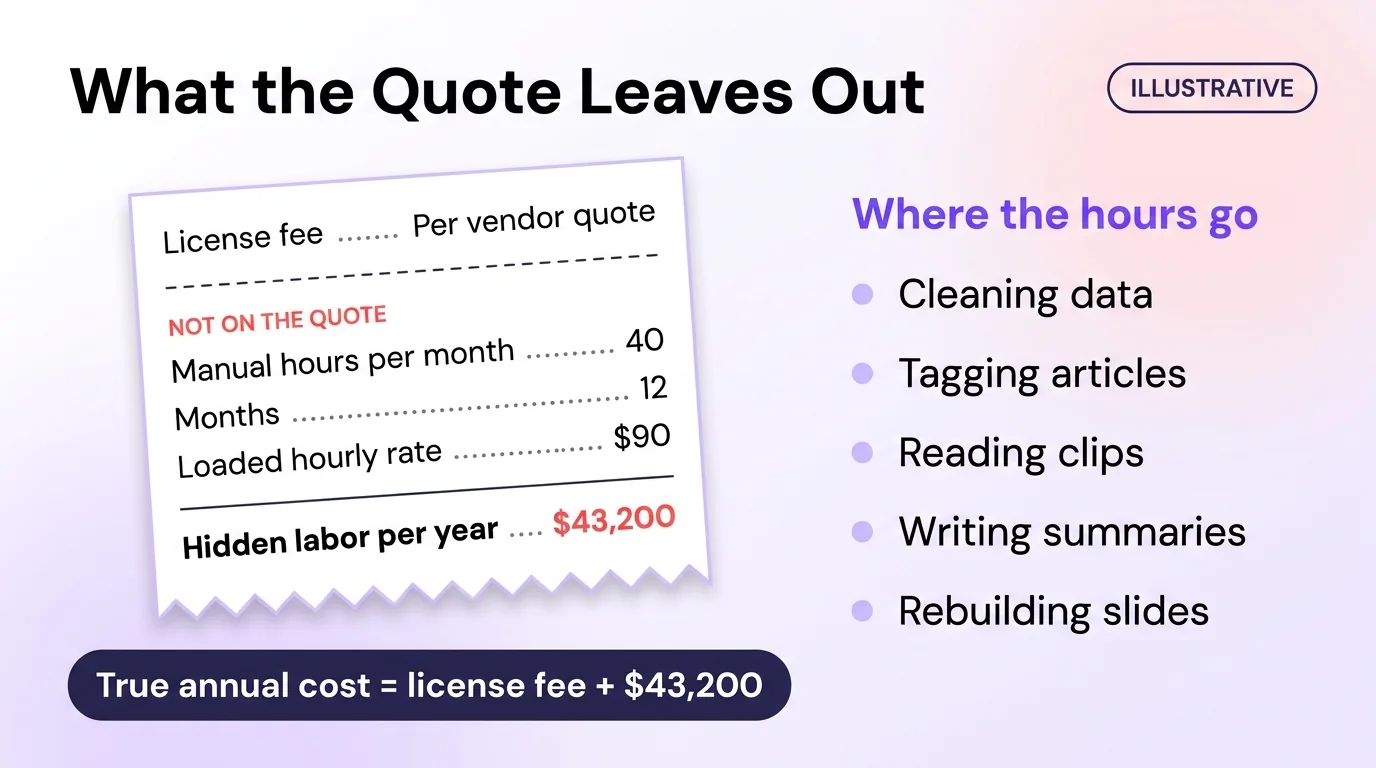
Count what your team still does by hand after the software runs. Are they cleaning data, tagging articles, reading clips, writing summaries, and rebuilding slides? None of that labor shows up on the vendor's quote. A good platform shrinks the list. The math below shows why that belongs in your comparison.
A platform that removes most of that work can cost more on paper and less in practice, so ask each vendor which manual steps disappear once you're live.
What Should Enterprise PR Software Handle Beyond Analytics?
Beyond analytics, enterprise PR software has to handle governance, integrations, and partner access well enough to clear security and procurement review. A strong analytics engine won't survive procurement if it fails your governance standards, so check these early.
Governance and AI transparency
Look for single sign-on, role-based permissions, audit logs, and clear data retention terms. For AI features, ask how outputs are generated, what data they draw on, and whether you can trace a conclusion to its sources. NIST's AI Risk Management Framework treats accountability, transparency, and explainability as core traits of trustworthy AI, which makes it a useful checklist to bring into vendor conversations.
Integrations and configuration
Briefings should land in the email and messaging apps leadership already uses, and analysts will want exports and a BI connection. Setup matters just as much as connectors. A conglomerate may need separate competitor sets for each business unit, while a global brand may need its own priority outlets in every market and a regional view that local teams can read without an analyst. If your agencies work from the same data, ask whether you can give them scoped access under your controls so both sides read the same narratives.
How Do You Test the Best PR Measurement Software Before You Buy?
Test software with one scorecard for every vendor and a short pilot on your own data. Score what you've seen demonstrated rather than what you've been told. Each criterion below pairs a question to ask in the demo with the red flag that should make you push harder before the contract reaches legal.
| Criterion | Question to ask the vendor | Red flag |
|---|---|---|
| Data coverage | Which sources do you license, and how do you handle paywalled content? | A huge source count with no answer on the outlets you care about |
| Relevance | How do you separate passing mentions and syndicated copies? | Relevance depends on Boolean strings your team maintains |
| Sentiment | Is sentiment scored for our brand or for the whole article? | One tone score per article |
| Narratives | Can you show the storylines forming across related coverage? | Analysis stops at article lists and keyword topics |
| Share of voice | Can we filter it by tier, sentiment, message, and narrative? | One overall percentage |
| AI perception | How do you measure what AI systems say about our narratives? | Prompt counts presented as the full picture |
| Evidence | Can every AI-generated conclusion be traced to source coverage? | Summaries with no path back to the articles |
| Executive output | What does a leadership briefing look like out of the box? | Exported charts that still need a written summary |
| Governance | What do you support for SSO, permissions, and audit logs? | Answers that wait until procurement |
Run the pilot with each finalist because polished demos hide most of the gaps a scorecard is meant to catch. Make every PR analytics platform on your shortlist work with your data. If you're also weighing broader media intelligence needs, see Choosing a Media Intelligence Platform.
Pick one real narrative. Choose a storyline that matters to leadership right now, ideally one with competitors in it.
Load your own competitive set and priority outlets. The setup effort you see in the pilot is the effort you'll live with.
Ask every platform the same hard question. For example, ask what changed in this narrative over the last 90 days and what drove it. Then ask how you're positioned against your top three competitors.
Check the evidence. Open the coverage behind each conclusion and see whether it holds up.
Hand the output to an executive. If they'd need an analyst to explain it, score it accordingly.
Frequently asked questions
The best PR measurement software for enterprise teams combines clean, relevant coverage with narrative-level analysis, brand-centric sentiment, filterable share of voice, AI perception measurement, and executive-ready briefings. It also has to meet enterprise PR software requirements for security and integrations. Choose the one that answers your leadership's real questions with evidence you can check.
Reporting tools collect coverage and package metrics like mentions and reach into reports. PR analytics software adds analysis such as sentiment, share of voice, and competitor comparisons. Communications intelligence platforms go a step further and explain which narratives are forming and what they mean for your reputation.
For most large organizations, yes. AI assistants summarize your coverage for buyers and investors, so how they describe your priority narratives is part of your reputation. Look for PR measurement software that connects AI perception back to the coverage and sources behind it rather than reporting a standalone visibility score.
Put Your Shortlist to a Real Test
Pick the platform that gets your team from coverage to a defensible answer fastest, across both the media and the AI systems that now repeat it. Bring your hardest narrative to every demo and compare what each one hands back.
Handraise is enterprise PR software from the team that built TrendKite, using patented Narrative Clusters™, brand-centric sentiment, Dynamic Share of Voice, and AI perception tracking to show the stories that define your brand. Explore Handraise PR analytics and measurement, and book a briefing to see your own narratives and what AI systems are saying about them.