Blog
Insights
Straightforward interfaces make navigation and actions more intuitive, reducing the learning curve for new users.

Matt Allison
Founder & CEO

Key Takeaways
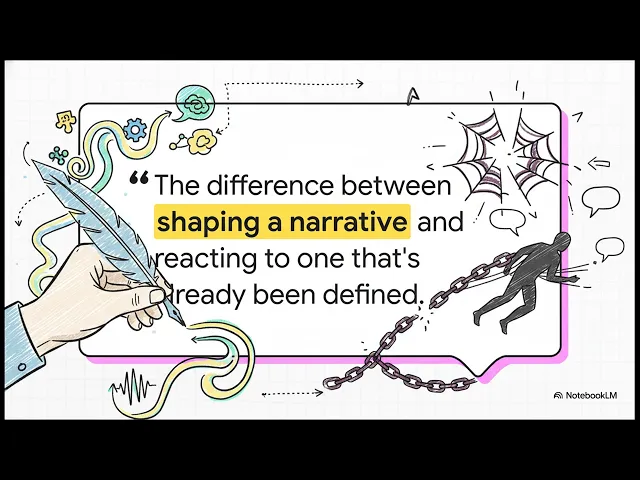
Real-time media monitoring is no longer a nice-to-have—it's the difference between shaping a narrative and reacting to one that's already been defined.
Corporate reputation accounts for 28% of S&P 500 market capitalization, totaling $11.9 trillion in value—making early narrative detection a financial imperative, not just a communications preference.
The most effective crisis responses happen within 24 to 48 hours of peak negative coverage, a window that traditional quarterly reporting cycles completely miss.
AI-powered narrative clustering replaces keyword-based alerts with contextual intelligence that groups related coverage into storylines, revealing what's forming—not just what's been published.
If your monitoring strategy still depends on Boolean logic and batch reports, you're consistently arriving after the narrative has already been set.
Corporate reputation now represents a measurable share of market value, and the narratives shaping that reputation form faster than most organizations can track them. A single product misstep, an executive's offhand remark, or an industry shift covered across dozens of outlets can coalesce into a dominant storyline within hours. The question facing communications leaders isn't whether to monitor media—it's whether their current approach delivers insight fast enough to matter.
Real-time media monitoring has evolved well beyond keyword alerts and daily digest emails. The organizations gaining a competitive edge detect emerging narratives as they form, understand sentiment through the lens of their specific brand, and respond with precision before external forces define the conversation. This article breaks down how modern monitoring works, why speed matters more than volume, and what communications teams should demand from their media monitoring tools in 2026 and beyond.
Why Real-Time Media Monitoring Has Become a Strategic Imperative
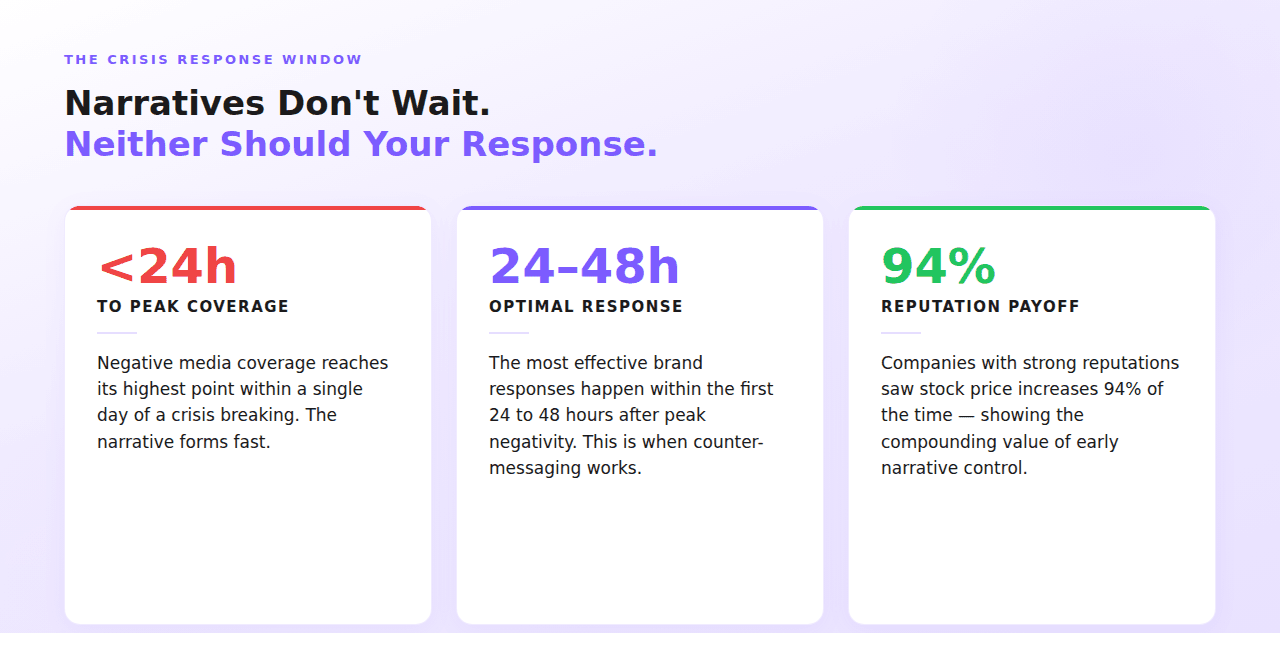
The business case for speed in communications intelligence has never been stronger. Echo Research's 2024 Reputation Dividend report found that corporate reputation drives 28% of market capitalization across the S&P 500, equivalent to $11.9 trillion in total value. Companies with strong reputations saw stock price increases 94% of the time, while those with poor reputations collectively lost $182 billion in market value. These aren't abstract figures—they represent direct financial exposure tied to how narratives form, spread, and stick.
Traditional media monitoring approaches struggle under this reality. Many communications teams still rely on processes that take an entire quarter to compile, clean, and analyze media data. By the time a report lands on a senior leader's desk, the narrative it describes has long since been cemented by journalists, social platforms, and increasingly, large language models that synthesize information for millions of users daily.
Real-time media monitoring eliminates that lag. Instead of retrospective summaries, it delivers continuous intelligence that enables teams to see what's forming, not just what's already happened.
The Speed Gap Between Detection and Response
Industry analysis of corporate crises reveals a consistent pattern: negative media coverage typically reaches its peak within a single day of breaking, and the most effective brand responses happen within the first 24 to 48 hours after that peak. Coverage then declines rapidly, but public opinion cements quickly during that narrow window. Slow responses don't just miss the moment—they allow the narrative to harden into the accepted version of events.
Consider the practical implications. If your monitoring software delivers a weekly summary every Monday morning, a crisis that peaked on Wednesday has already been running for five days without an informed response. By the time leadership sees the data, the conversation has moved on—but the reputational damage remains. Monitoring that operates in real time closes this gap, giving teams the information they need during the window when counter-messaging can still shift perception.
How Does AI-Powered Media Monitoring Detect Emerging Narratives?
Detecting emerging narratives requires more than simply tracking mentions faster. It demands a fundamentally different analytical approach—one that moves beyond individual articles to understand the larger storylines those articles contribute to.
From Keywords to Narrative Clusters
Legacy media monitoring tools depend on Boolean queries: strings of keywords, operators, and exclusions that teams manually build and maintain. This approach only finds what you're already looking for—and treats every mention as an isolated data point rather than part of a broader story.
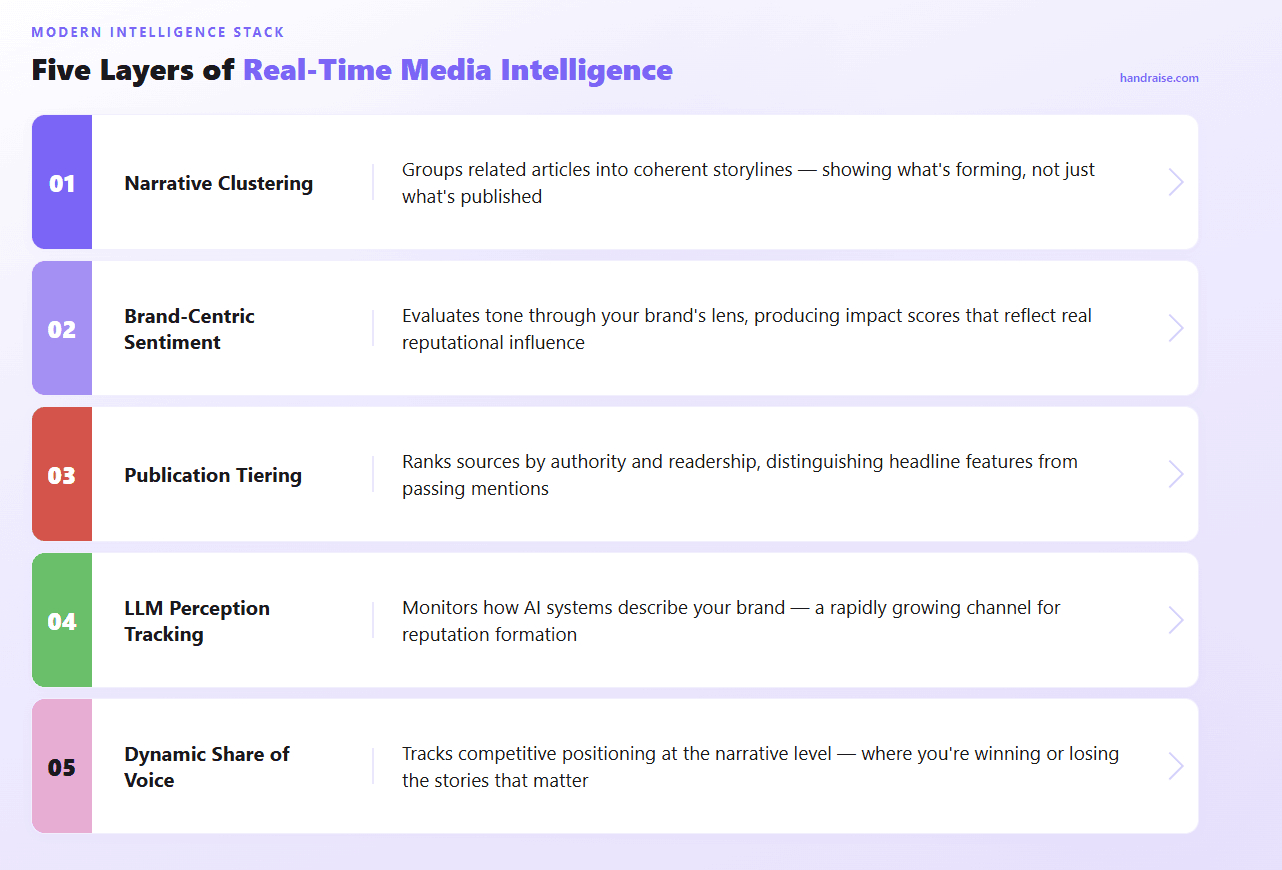
Modern platforms use AI to cluster related coverage into coherent narratives. Rather than showing you 500 individual articles, this approach reveals five or six distinct storylines, each with its own trajectory, sentiment profile, and level of momentum. Narrative clustering analyzes context, framing, sourcing patterns, and thematic connections across articles. When multiple outlets begin covering the same underlying story—even if they use different language and angles—the system identifies the emerging pattern and surfaces it as a cohesive narrative.

Publication Tiering and Brand Prominence
Not every mention carries equal weight. A passing reference in a niche blog carries a fundamentally different reputational impact than a headline feature in a Tier 1 business publication. Effective monitoring accounts for this by applying publication tiering based on domain authority, readership, and industry relevance, along with brand prominence scoring that distinguishes between headline coverage and incidental mentions. Without tiering, teams either over-react to insignificant mentions or under-respond to genuinely consequential coverage.
Brand-Centric Sentiment Analysis
Standard sentiment analysis tools classify content as positive, negative, or neutral—a blunt instrument that often misses what matters most. Advanced media monitoring tools apply brand-centric sentiment analysis that evaluates tone and framing through the lens of your specific brand, generating impact scores that reflect actual reputational influence rather than generic linguistic polarity. When a story clusters around a competitor's failure and your brand appears as a favorable alternative, generic tools might flag the entire cluster as negative. Brand-centric analysis recognizes your positive positioning within that context.
What Competitive Advantages Does Real-Time Media Monitoring Deliver?
Organizations that invest in narrative-level intelligence gain specific, measurable advantages over those still relying on traditional approaches.
Capability | Traditional Monitoring | Real-Time Narrative Intelligence |
Detection Speed | Hours to days after publication | Minutes after publication |
Analysis Depth | Individual mention tracking | Narrative-level clustering |
Sentiment Accuracy | Generic positive/negative/neutral | Brand-specific impact scoring |
Reporting Cycle | Weekly or quarterly reports | Continuous, always-on intelligence |
Competitive Context | Static share of voice snapshots | Dynamic competitive positioning |
AI/LLM Coverage | Not typically included | LLM perception tracking |
Crisis Detection and Rapid Response
The highest-stakes application of this intelligence is crisis detection. When negative coverage begins accelerating, the difference between catching it at 10 articles versus 1,000 articles determines whether your response shapes the narrative or chases it. Modern platforms surface anomalies—sudden spikes in mention volume, shifts in sentiment trajectory, or the emergence of a new negative narrative cluster—and deliver prioritized alerts that cut through noise. Communications teams using always-on monitoring develop a baseline understanding of normal coverage patterns, making anomalies immediately visible while the response window remains open.
Campaign Measurement in Motion
Traditional PR measurement treats campaigns as completed events to be analyzed retrospectively. Always-on monitoring transforms campaign tracking into an ongoing feedback loop. Teams can see which messages are resonating, which narrative frames are being adopted by coverage, and which elements need adjustment—all while the campaign is still active. This shift from post-mortem to in-flight optimization represents a significant advantage, and resource allocation can follow narrative momentum rather than pre-determined schedules.
Dynamic Share of Voice
Static share of voice calculations—typically based on simple mention counts over a fixed period—miss the nuance of competitive positioning. A brand might have fewer total mentions than a competitor but dominate the narratives that matter most to stakeholders. Dynamic share of voice analysis tracks competitive positioning at the narrative level, revealing where a brand is winning or losing the conversations that influence reputation and investor confidence.
What Role Do LLMs Play in Modern Media Monitoring?
The 2025 Reuters Institute Digital News Report revealed that a growing number of consumers—particularly younger audiences—now turn to AI chatbots as information sources. This shift introduces a new dimension to PR media monitoring that most legacy tools ignore: how large language models describe and position your brand.
When someone asks an AI assistant about companies in your industry, the response draws from earned media and web content. The narratives embedded in that coverage directly influence how your brand appears in AI-generated answers. If negative coverage dominates, LLMs will reflect that framing—potentially reaching millions of users who never read the original articles.

Monitoring AI Perception
Forward-thinking communications teams now track LLM perception alongside traditional media sentiment, mapping AI-generated responses back to the earned media narratives that inform them. The goal isn't just awareness—it's influence. By understanding which narratives LLMs prioritize, teams can develop content strategies that optimize how AI systems represent their brand. Organizations that monitor only human audiences are overlooking a rapidly growing channel through which millions of people form brand impressions every day.
Monitoring Dimension | What It Tracks | Why It Matters |
Traditional Media | Print, broadcast, digital outlets | Foundation of earned media coverage |
Social Amplification | Shares, comments, engagement | Measures narrative reach beyond publication |
Narrative Clustering | Storyline formation and trajectory | Reveals what's forming, not just what's published |
LLM Perception | AI-generated brand descriptions | Growing channel for brand impression formation |
Competitive Dynamics | Relative positioning across narratives | Shows where you're winning or losing |
5 Capabilities Your Media Monitoring Tools Should Deliver
Not all platforms marketed as real-time solutions deliver the depth of intelligence that modern communications teams need. When evaluating media monitoring software, look for these essential capabilities.
AI-driven narrative clustering. The platform should automatically group related coverage into coherent narratives, revealing storylines rather than isolated mentions. This is the single most important differentiator between legacy monitoring and modern intelligence.
Brand-centric sentiment scoring. Generic sentiment analysis isn't enough. Your platform should evaluate tone and framing specifically through the lens of your brand, producing impact scores that reflect actual reputational influence.
Publication tiering with prominence detection. The system should automatically classify sources by authority and readership while distinguishing between headline coverage and passing mentions. This enables smarter resource allocation and response prioritization.
LLM and AI perception monitoring. As AI becomes a primary information channel, monitoring should include how large language models describe your brand and how earned media narratives influence those AI-generated descriptions.
Real-time competitive intelligence. Dynamic share of voice tracking at the narrative level should reveal where your brand is gaining or losing ground against competitors—not just counting who has more mentions this month.
Frequently Asked Questions About Real-Time Monitoring
How quickly can real time media monitoring detect a crisis?
Modern platforms can detect anomalous coverage patterns within minutes of publication. The key differentiator is whether the platform simply alerts you to volume spikes or provides contextual intelligence about which narratives are forming and their potential trajectory. Volume alerts without narrative context create noise; narrative intelligence enables informed action.
What's the difference between media monitoring and media intelligence?
Media monitoring is the collection layer—scanning sources and capturing mentions. Media intelligence adds analysis, clustering coverage into narratives, applying brand-specific sentiment, and delivering strategic recommendations. Most communications teams need intelligence, not just monitoring, to make strategic decisions under time pressure.
How does modern monitoring address AI and LLM coverage?
Advanced platforms track how large language models describe your brand, mapping AI-generated responses back to the earned media narratives that inform them. This is increasingly important as more professionals use AI assistants as primary information sources.
Can you measure campaign performance while a campaign is still running?
Yes—by tracking which messages are being adopted in coverage, how narrative framing evolves, and how share of voice shifts in real time, teams can adjust strategy during a campaign rather than only evaluating after it concludes.
Start Seeing Narratives Before They Set
The communications landscape moves fast, but the tools available to navigate it are finally catching up. Real-time media monitoring built around narrative intelligence—rather than simple keyword tracking—gives communications leaders the visibility they need to detect what's forming and act before the narrative is defined by someone else. For teams ready to move beyond retrospective reporting, Handraise delivers the clarity and speed that modern reputation engineering demands. Book a demo to see how AI-powered narrative clustering, brand-centric sentiment, and LLM monitoring work together to keep your team ahead of the story.
Matt Allison
Founder & CEO
Share