Blog
Insights
Straightforward interfaces make navigation and actions more intuitive, reducing the learning curve for new users.

Matt Allison
Founder & CEO

Key Takeaways
Media monitoring has evolved from simple mention-tracking to narrative intelligence—and communications teams that fail to adapt risk losing control of their brand story.
Over half of PR professionals use media monitoring software daily, yet half of communications leaders say they lack effective tools to measure impact
Traditional Boolean-based monitoring surfaces too much noise; modern approaches cluster coverage into narratives that reveal what actually shapes perception
Real time media monitoring enables crisis prevention rather than crisis response—the difference between five minutes and five days can define a brand's reputation
The rise of AI and LLMs as information sources means monitoring must now track how algorithms describe your brand, not just journalists
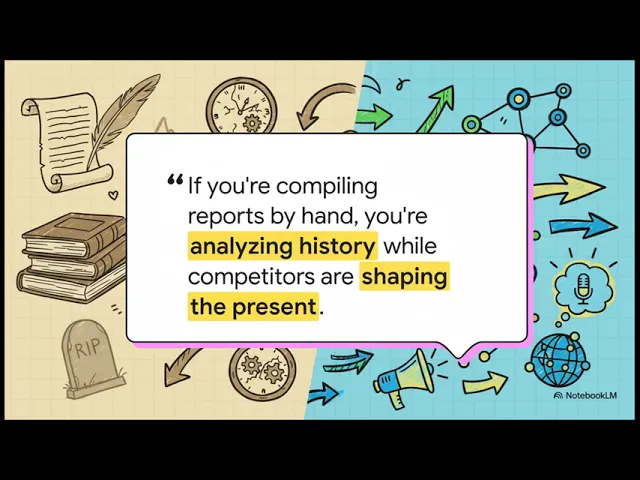
If your team is still compiling quarterly reports by hand, you're analyzing history while competitors are shaping the present.
Communications professionals face a paradox: there's more data available about brand coverage than ever before, yet gaining actionable insight feels harder than it did a decade ago. The sheer volume of content generated across digital channels—news sites, social platforms, podcasts, broadcast—has made traditional approaches to tracking brand perception feel like drinking from a firehose.
Media monitoring sits at the center of this challenge. Done well, it transforms noise into clarity and gives PR teams the intelligence they need to protect reputation, measure campaign performance, and respond to emerging issues before they spiral. Done poorly, it produces dashboards full of mentions that tell you very little about what actually matters.
This guide breaks down what modern media monitoring looks like, why legacy approaches fall short, and what enterprise communications leaders should prioritize when building or upgrading their monitoring strategy.
What Is Media Monitoring and Why Does It Matter?
Media monitoring is the systematic process of tracking, collecting, and analyzing coverage about your brand, competitors, and industry across media channels. Those channels include online news, print publications, broadcast television, radio, podcasts, social media platforms, and increasingly, AI-generated content.
The practice dates back to the 1850s, when PR professionals clipped newspaper articles by hand to track press coverage. The fundamentals haven't changed—you still need to know what's being said about your brand and where—but the scale and speed have transformed entirely. Today, there are an estimated 50 billion internet-connected devices worldwide, with hundreds of thousands of pieces of content published every minute.
For PR and corporate communications teams, media monitoring serves several critical functions. It enables reputation protection by surfacing negative coverage or emerging issues early enough to respond. It provides competitive intelligence by tracking what's being said about rivals in your space. It supports campaign measurement by documenting coverage earned from proactive outreach. And it informs strategy by revealing which messages resonate and which fall flat.
The stakes are significant. Research from Harvard Business Review found that companies with poor reputations must offer an average of 10% more compensation per hire just to attract talent. Reputation affects everything from customer acquisition to investor confidence—and media coverage plays an outsized role in shaping that perception.
How Has Media Monitoring Evolved for PR Teams?
The gap between legacy media monitoring and what modern communications teams actually need has widened considerably. Understanding this evolution helps explain why so many professionals remain frustrated with their current tools.
Traditional PR media monitoring relied heavily on Boolean search queries—complex strings of keywords, operators, and exclusions designed to surface relevant coverage. Building these queries required technical expertise, and even well-constructed searches produced significant noise. Generic brand names triggered false positives. Nuanced coverage slipped through. The process of refining searches to improve accuracy consumed hours that communications professionals didn't have.
The output was equally problematic. Legacy systems produced mention counts and impressions—vanity metrics that told you how many times your brand appeared but nothing about whether that coverage helped or hurt your reputation. A passing mention in a negative article counted the same as a feature story with key message pull-through.
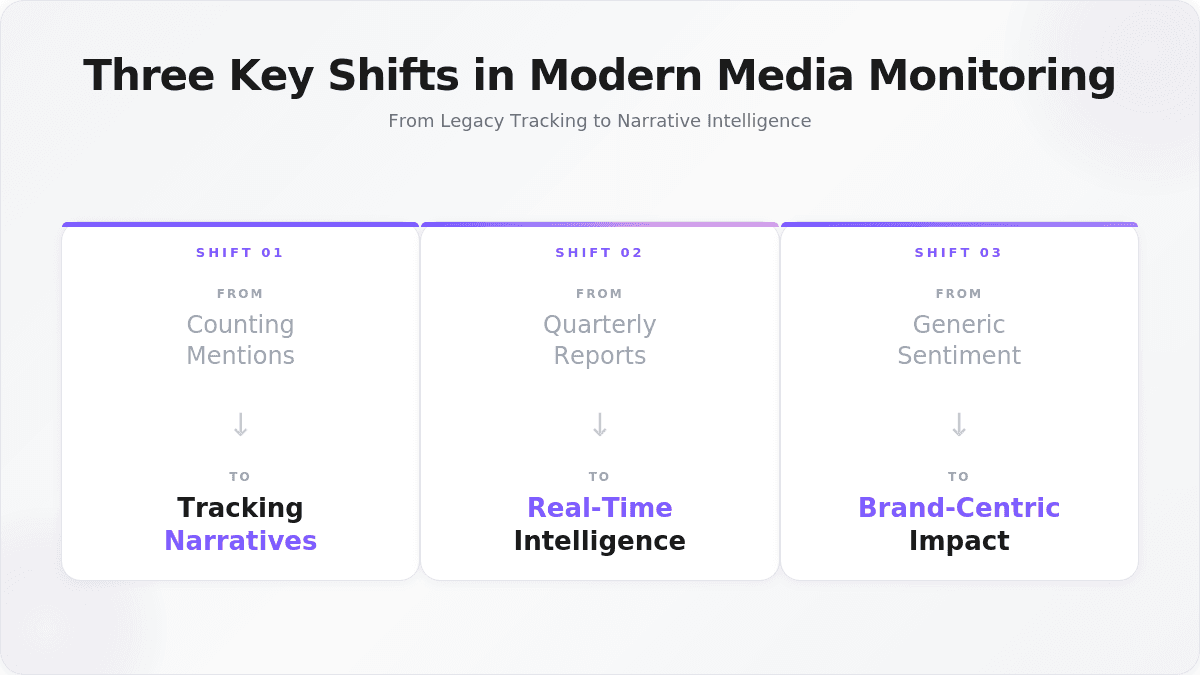
Traditional Monitoring | Modern Monitoring |
Boolean search queries | AI-powered news discovery |
Mention counts | Narrative analysis |
Generic sentiment (positive/negative/neutral) | Brand-centric sentiment tied to specific audiences |
Static share of voice | Dynamic share of voice by topic and competitor |
Manual report compilation | Real-time dashboards and alerts |
Quarterly analysis cycles | Continuous intelligence |
Modern media monitoring tools address these limitations through artificial intelligence and machine learning. Rather than relying on keywords, advanced platforms analyze content contextually to determine relevance. They distinguish between a headline mention and a passing reference. They identify publication tier based on domain authority and readership, not just whether the outlet name appears in a database.
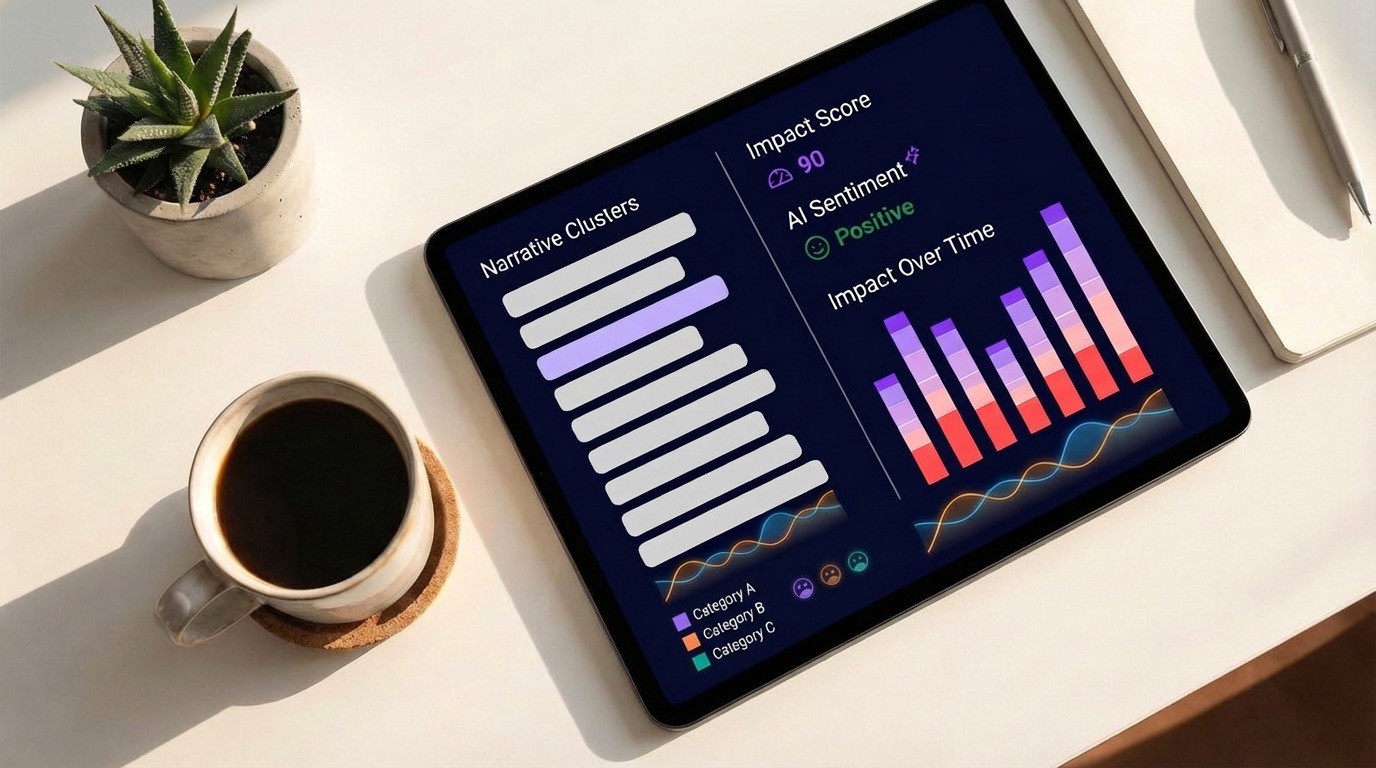
The most significant shift involves moving from mentions to narratives. Individual articles don't shape reputation in isolation—narrative clusters that group similar coverage together reveal the stories actually driving perception. A single critical article might be an anomaly; dozens of articles echoing the same theme signal a reputation risk that demands attention.
What Should Modern Media Monitoring Tools Actually Track?
Effective media monitoring extends well beyond basic mention tracking. Enterprise communications teams need intelligence across multiple dimensions to inform strategy and demonstrate value.
Coverage Volume and Velocity
Understanding how much coverage your brand receives—and how quickly it accumulates—provides baseline context. Spikes in volume often signal breaking news or emerging issues that require immediate attention.
Publication Tiering and Authority
Not all coverage carries equal weight. Modern media monitoring tools should automatically classify coverage by publication tier based on domain authority or verified readership rather than subjective editorial judgment.
Sentiment Analysis That Actually Works
Legacy sentiment analysis applied generic NLP to determine whether coverage was positive, negative, or neutral. The problem: sentiment depends entirely on context. Effective brand-centric sentiment analysis evaluates tone through the lens of how it impacts your specific brand with your specific audiences.
Key Message Penetration and Share of Voice
PR campaigns aim to drive specific messages into earned media. Monitoring should track whether those messages appear—and whether they're attributed correctly. Dynamic share of voice goes beyond mention percentages to analyze share within specific narratives, revealing where you're winning and where competitors dominate.
Social Amplification
Tracking social shares per article helps identify which stories resonate with audiences and which disappear without engagement.
5 Core Benefits of Real Time Media Monitoring
Real time media monitoring transforms communications from a reactive function to a proactive one. The difference between learning about negative coverage immediately versus days later can determine whether a story dies quietly or becomes a full-blown crisis. Here's why PR media monitoring in real time has become non-negotiable for enterprise teams.
Crisis Prevention and Early Warning The most valuable monitoring alert is the one that arrives before a problem escalates. Real time media monitoring surfaces emerging issues when response options remain open—before journalists start calling for comment on a story that's already been framed negatively. Research indicates that less than half of organizations have a formal crisis plan, making early detection even more critical.
Rapid Response Capability When coverage does turn negative, speed matters. Real time alerts enable communications teams to assess the situation, coordinate messaging, and respond through appropriate channels while the story is still developing. Waiting for a weekly monitoring report means reacting to yesterday's news.
Campaign Optimization in Flight Traditional quarterly analysis arrived too late to inform current campaigns. Real time monitoring lets teams track coverage as it happens, identify which angles are gaining traction, and adjust outreach strategy accordingly. If key messages aren't landing, you'll know within days rather than months.
Stakeholder Intelligence Executives, board members, and investor relations teams often need immediate visibility into coverage affecting the organization. Real time dashboards and automated alerts keep stakeholders informed without requiring manual briefing documents for every media mention.
Competitive Awareness Monitoring competitors in real time reveals their PR strategies, product announcements, and reputation vulnerabilities as they emerge. This intelligence informs everything from messaging positioning to proactive media opportunities.
Why Does Traditional Monitoring Fall Short in the AI Age?
Large language models have created an entirely new dimension of brand perception that legacy monitoring ignores completely.
When consumers ask ChatGPT, Claude, or Google's AI features about products, services, or companies, the responses shape perception just as powerfully as traditional media. These AI systems draw from earned media to formulate answers—which means narratives in your coverage today influence how algorithms describe your brand tomorrow.
Most monitoring tools don't track AI perception at all. Teams have no visibility into how LLMs currently describe their brand or whether recent coverage has shifted that perception. Organizations that understand and optimize for AI visibility can influence how algorithms represent them to millions of users.
Monitoring LLM perception requires analyzing what narratives LLMs cite, tracking how citations change over time, and identifying gaps between desired positioning and current AI-generated descriptions. This capability represents the frontier of reputation engineering in the AI age.
What Legacy Tools Track | What Modern Teams Need |
Print, online, broadcast mentions | All traditional channels plus podcast monitoring |
Generic keyword matches | Contextual relevance and brand prominence |
Overall sentiment score | Brand-specific, audience-specific sentiment |
Total mention counts | Narrative clusters showing story-level trends |
N/A | LLM/AI perception and citation tracking |
Static quarterly reports | Real-time dashboards with automated alerts |
How Should Communications Teams Evaluate Media Monitoring Tools?
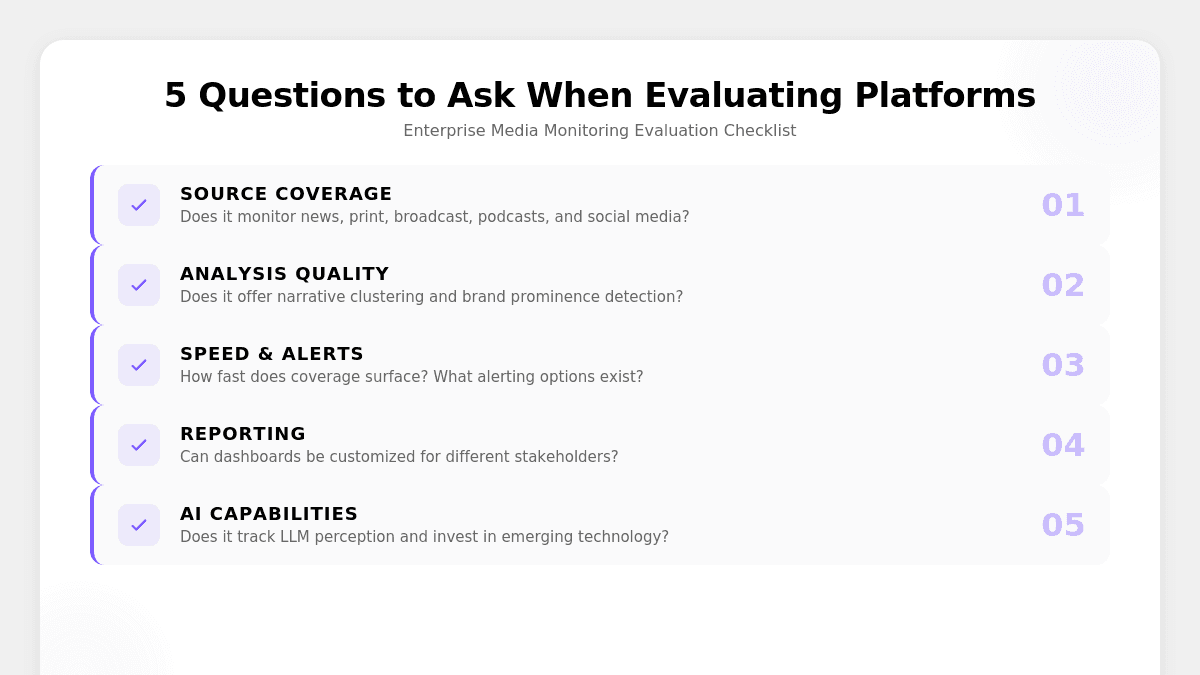
Selecting the right media monitoring platform requires matching capabilities to organizational needs. Enterprise communications teams should evaluate potential solutions against several criteria.
Source Coverage and Analysis Quality
Does the platform monitor all relevant channels—online news, print, broadcast, podcasts, social media? Are international sources included? How does it determine sentiment—does it offer narrative clustering or only mention tracking? Can it distinguish brand prominence automatically?
Speed, Alerting, and Reporting
How quickly does coverage surface after publication? What alerting options exist? Does the platform support the metrics that matter to your stakeholders? Can dashboards be customized for different audiences?
Integration and Future Capabilities
Can the platform integrate with existing tools? Does it support collaboration for distributed teams? Does it track LLM perception? How is it investing in AI capabilities that will matter in the coming years?
Frequently Asked Questions About Media Monitoring
What's the difference between media monitoring and social listening?
Media monitoring traditionally focused on earned media coverage—news articles, broadcast segments, editorial content. Social listening tracks conversations on social platforms. Modern platforms increasingly combine both capabilities, recognizing that brand perception forms across all channels.
How much do media monitoring tools cost?
Pricing varies dramatically based on features, source coverage, and user seats. Basic solutions start at a few hundred dollars monthly, while enterprise platforms can reach five figures annually. The USC Annenberg Center for Public Relations notes that communications budgets face ongoing scrutiny, making it essential to demonstrate monitoring ROI.
Can smaller teams benefit from professional media monitoring?
Absolutely. The core benefits—early issue detection, campaign measurement, competitive intelligence—apply regardless of team size. Even basic real time alerts can prevent reputation damage that far exceeds monitoring costs.
How do I get executives to care about media monitoring data?
Translate monitoring data into language executives understand: reputation risk, competitive positioning, campaign ROI. Frame coverage trends in terms of potential impact on customer acquisition, investor confidence, or talent recruitment. Connecting media intelligence to business outcomes earns monitoring a seat at the strategic table.
Take Control of Your Brand Narrative
Media monitoring has evolved from a simple tracking function into a strategic intelligence capability that separates reactive communications teams from those who shape perception proactively. The organizations that thrive are those who understand that mentions don't equal reputation—narratives do.
Modern enterprise communications leaders need platforms that go beyond Boolean searches and mention counts to deliver genuine narrative intelligence. They need real time visibility, brand-centric sentiment analysis, dynamic share of voice measurement, and increasingly, insight into how AI systems perceive and describe their brand.
Handraise was built from the ground up to solve these challenges, transforming messy media data into clear, actionable narrative intelligence. If your team is ready to stop counting mentions and start engineering reputation, book a demo to see how modern communications intelligence actually works.
Matt Allison
Founder & CEO
Share