Blog
Insights
Straightforward interfaces make navigation and actions more intuitive, reducing the learning curve for new users.

Matt Allison
Founder & CEO

Key Takeaways
The terms "media monitoring tools" and "media monitoring software" are often used interchangeably, but for enterprise communications leaders, the distinction matters.
Point tools handle specific tasks like alerts or social tracking, while software platforms integrate monitoring, analysis, and intelligence into a unified system.
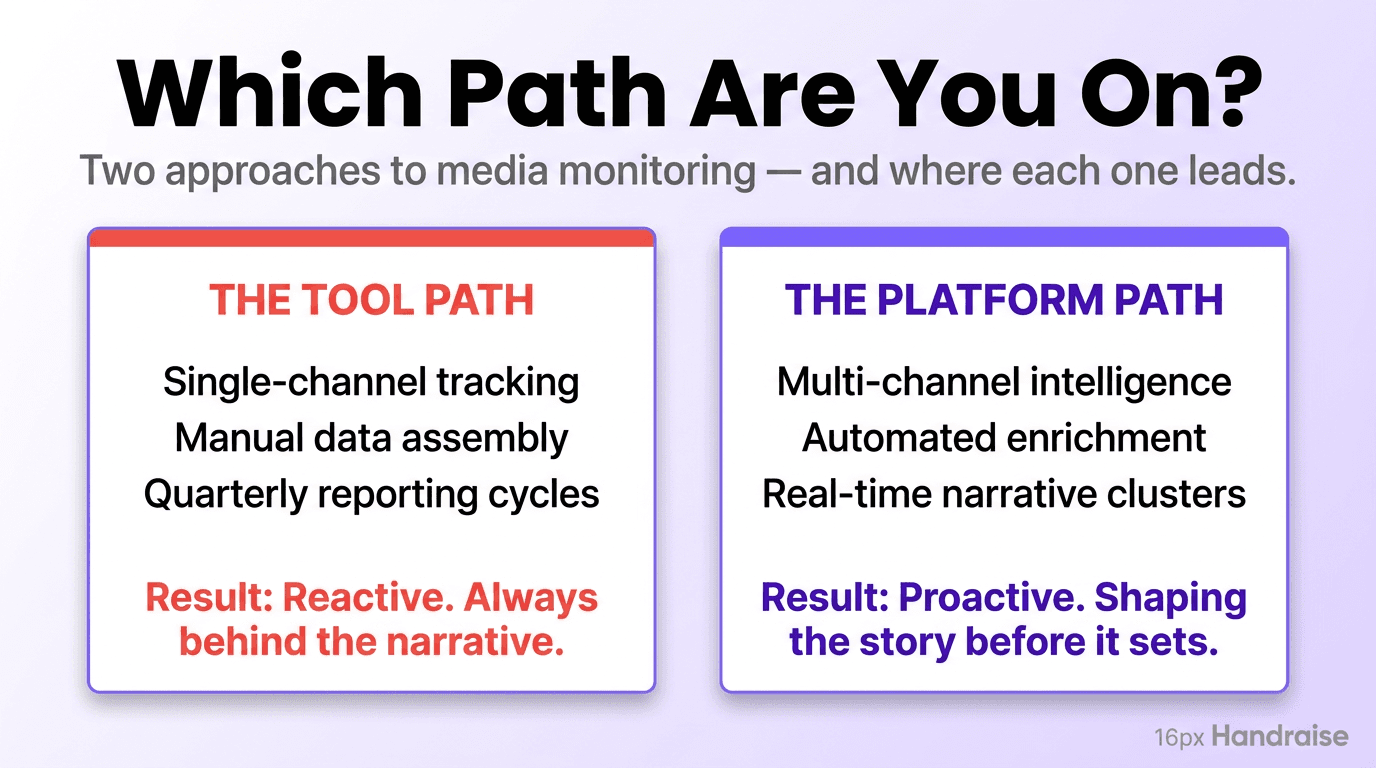
Most legacy approaches to media monitoring still lead to quarterly reporting cycles that arrive too late to influence the narrative.
The next generation of communications intelligence goes beyond mentions to surface narrative clusters, brand-centric sentiment, and AI perception data.
If you're evaluating coverage tracking platforms today, the smarter question is whether your solution turns raw data into actionable strategy, in real time.
The market for communications intelligence platforms is growing fast. According to market research from Grand View Research, the global market was valued at approximately $5.46 billion in 2024 and is projected to reach over $12 billion by 2030, growing at a compound annual growth rate of 14.1%. That growth tells you something important: enterprises are no longer treating media monitoring as a back-office function. It's becoming a strategic priority.
But as the category has expanded, so has the confusion around terminology. Walk into any software evaluation conversation and you'll hear "media monitoring tools" and "media monitoring software" used as though they mean the same thing. They don't, at least not always, and the difference matters more than most buyers realize before they're locked into a contract.
This post breaks down exactly what separates a media monitoring tool from a full media monitoring software platform, which buyer profile fits each, and what the category is evolving toward for communications leaders who need something beyond a dashboard full of mentions.
What Are Media Monitoring Tools?
A media monitoring tool is software that tracks brand mentions, news coverage, or social conversations within a defined channel or use case. The term typically refers to purpose-built, specialized solutions rather than comprehensive platforms. Think of them as the specialists of the category.
Different platforms specialize in different media types: news and press tools track online publications, print outlets, and wire services; broadcast software captures TV, radio, and podcast mentions; and social monitoring platforms focus on channels, forums, blogs, and review sites.

A tool in this sense might be a standalone alert system, a social listening add-on, or a keyword tracker built for one channel. These solutions are often lighter in architecture, faster to deploy, and easier to budget for in smaller teams. The tradeoff is scope.
The Strengths of Specialized Tools
Point solutions can be genuinely useful when your monitoring needs are narrow and well-defined. If your communications team only needs to track press pickup in a specific vertical or monitor social mentions around a product launch, a purpose-built tool may be enough. They tend to have lower barriers to entry, both in terms of cost and technical setup, and can be integrated into existing workflows without a major overhaul.
Purpose-built solutions allow brands to keep a close eye on public perception, spot trends, and identify key opportunities or risks within their defined scope. For teams with limited needs, that core function may be sufficient. The challenge comes when those teams grow, when narratives become more complex, or when leadership starts asking questions the tool can't answer.
Where Single Tools Fall Short
The coverage gap is the most common complaint. Free tools like Google Alerts provide basic web mention tracking but lack sentiment analysis, social coverage, and real-time alerts. Paid point tools improve on that baseline, but they typically still require teams to manually stitch data together across sources before any real analysis can happen.
For many communications teams, that manual effort adds up to hours of work per week spent on data assembly rather than decision-making. It's the kind of overhead that accumulates quietly, until the day leadership asks for a strategic briefing and there's no time left to analyze what the data is actually saying.
What Is Media Monitoring Software?
Media monitoring software is an integrated platform that handles the full cycle of coverage collection, data enrichment, sentiment analysis, and reporting within a single system. At the enterprise level, this means far more than alerts and clip counts. It's the difference between a hammer and a fully equipped workshop.
Software platforms of this kind are used by PR professionals, marketers, and brand managers to gain insights into public perception and manage reputation across every channel simultaneously. But the better platforms go much further than mention tracking. They layer in sentiment analysis, source tiering, competitive benchmarking, and increasingly, AI-driven narrative intelligence.
Core Features That Separate Platforms from Point Tools
A full media monitoring software platform typically offers several capabilities that isolated tools simply can't match:
Integrated data ingestion: Pulling in coverage across news, broadcast, podcasts, and social channels, then cleaning and enriching it automatically, without requiring a human to aggregate it manually.
Sentiment and impact analysis: Moving beyond positive/negative/neutral to evaluate brand-centric sentiment, meaning how coverage lands specifically for your organization, not just how it reads in general.
Publication tiering and prominence tagging: Identifying whether a brand appears in a headline versus a passing mention, and weighting that coverage by the authority and reach of the source.
Dynamic share of voice: Tracking how your brand's narrative presence shifts over time relative to the broader conversation in your category.
Here's how the two categories compare at a glance:
Feature | Media Monitoring Tools | Media Monitoring Software Platforms |
Channel coverage | Typically 1-2 channels | Multi-channel (news, social, broadcast, print) |
Sentiment analysis | Basic or absent | Brand-centric, nuanced |
Data enrichment | Minimal | Automated tagging, tiering, prominence |
Reporting | Manual compilation | Integrated, real-time dashboards |
Narrative intelligence | Not typically included | Advanced platforms include clustering |
AI/LLM perception tracking | Rare | Available in next-gen platforms |
Ideal for | SMBs, specific use cases | Enterprise communications teams |
How Do PR Media Monitoring Needs Differ by Buyer?
Understanding the tool vs. software distinction also means understanding who's buying what, and why.
Smaller marketing teams and solo PR practitioners often find that a focused point solution meets their needs. They're tracking a manageable volume of mentions, working within one or two channels, and producing reports that inform a relatively simple strategy. For them, cost efficiency and ease of use outweigh the need for deep integrations or AI-powered analysis.
Enterprise communications leaders face a different set of challenges. A brand story today can start on TikTok, spread to X, get picked up by a trade publication, reach mainstream media, and circle back to Reddit within 24 hours. Most monitoring tools were never built to track that kind of movement. Senior VPs and Directors of Communications need to know not just that a story ran, but what narrative it's feeding, how prominent the brand was in it, and whether the coverage is building or eroding the reputation they're trying to engineer.
What Enterprise Teams Are Actually Buying
When an enterprise communications leader evaluates media monitoring software, they're rarely shopping for mention volume. They're shopping for speed, clarity, and strategic relevance. They need to know what's forming in the media landscape before it solidifies, not after it's already defined their brand to a journalist, an investor, or an AI system.
That last point deserves more attention. LLMs like ChatGPT, Perplexity, and Gemini increasingly pull from earned media to answer questions about brands. Research from Omniscient Digital's analysis of 23,000+ AI citations found that when users ask an LLM about a brand, earned media sources account for nearly half of all citations. What gets written about your organization shapes how AI systems describe it to millions of people every day. That's a dimension of PR media monitoring that didn't exist five years ago, and most legacy tools haven't caught up. Next-generation platforms are now beginning to include LLM impact analysis specifically to address this gap.
What Should You Actually Look for in a Media Monitoring Platform?
If you're evaluating options for an enterprise communications function, the feature checklist matters less than the strategic questions underneath it. Here are the ones that tend to separate adequate from excellent.
Does It Surface Narratives, Not Just Mentions?
There's a fundamental difference between knowing your brand was mentioned 400 times last month and understanding that those 400 mentions cluster into three distinct narratives, one positive, one neutral, one emerging as a potential risk. The latter is what actually informs strategy. Look for platforms that group coverage into narrative clusters automatically, so your team can see the stories forming around your brand rather than scrolling through individual clips.
Does It Enrich Coverage or Just Collect It?
Raw coverage is noise. Enriched coverage, tagged for publication authority, brand prominence, social amplification, and sentiment, is intelligence. The best media monitoring software does this enrichment automatically and consistently, without requiring your team to build Boolean queries or clean up irrelevant pulls.
How Fast Does Intelligence Actually Move?
If your platform is generating a monthly or quarterly summary, the narrative has already been set by the time you act on it. Real-time intelligence isn't a nice-to-have at the enterprise level. It's the whole point. The gap between when a story begins forming and when a quarterly report lands can be the difference between shaping the narrative and reacting to one that's already been established without you.
Does It Track How AI Perceives Your Brand?
This is the emerging differentiator. As LLMs become a primary research channel for executives, journalists, and consumers, understanding how AI systems describe your brand has become as important as understanding what journalists write about it. Platforms that include LLM impact analysis are no longer futuristic. They're a practical necessity for enterprise communications leaders who want to practice genuine Reputation Engineering™.
Features to Prioritize at a Glance
Here's a quick reference for what to evaluate, depending on where your team sits:
Priority | Emerging Teams | Enterprise Communications Leaders |
Real-time alerts | Yes | Yes (baseline requirement) |
Narrative clustering | Nice-to-have | Essential |
AI/LLM perception tracking | Not yet needed | High priority |
Brand-centric sentiment | Helpful | Required |
Dynamic share of voice | Optional | Strategic must-have |
Publication tiering | Helpful | Required |
Automated enrichment | Helpful | Required |
Why Are So Many Teams Still Using the Wrong Type of Tool?
It's a fair question. If full media monitoring software platforms offer so much more, why are communications teams still working with fragmented point solutions stitched together with spreadsheets?
A few reasons tend to come up consistently. First, procurement cycles are slow, and many enterprise teams are locked into contracts with legacy platforms that made promises they couldn't fully keep. Second, there's a tendency to confuse surface-level sophistication, a polished dashboard and a lot of alerts, with actual intelligence capability. Third, the buyers who know what they need are often not the ones signing the contracts.
The teams most likely to evolve past point tools are those where the VP or Senior Director of Communications is directly involved in the evaluation. They understand that the evolution of media monitoring is not just about adding more data sources. It's about transforming raw coverage into strategic clarity, fast enough to actually act on it.
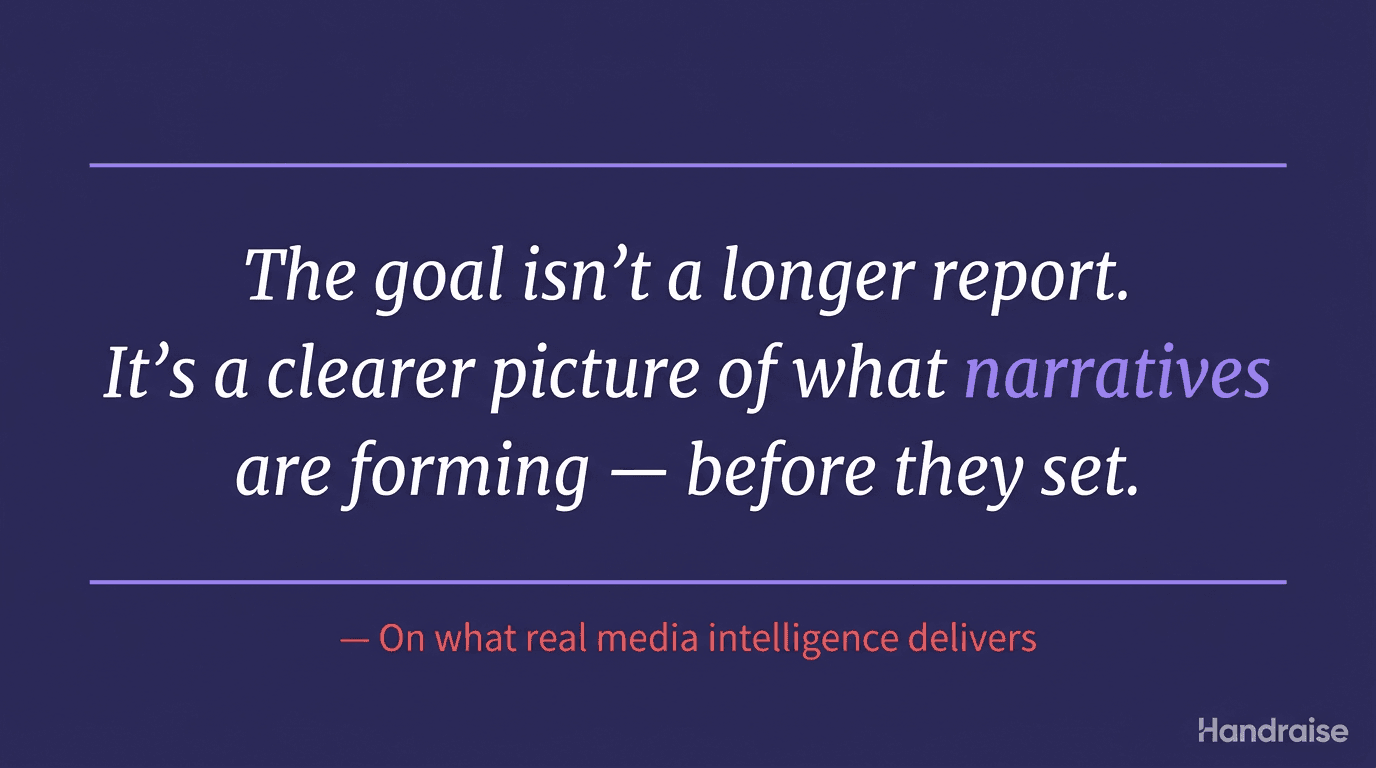
That shift also requires rethinking what good PR media monitoring looks like as an output. The goal isn't a longer report. It's a clearer picture of what narratives are forming, which ones carry risk, and where the next story is heading before it breaks. Teams that invest in narrative intelligence for enterprise teams and make it part of their measurement model are the ones building reputations proactively instead of reacting to ones that were set without them.
Frequently Asked Questions
Is media monitoring software the same as a media monitoring tool?
Not exactly. Point solutions in this category are designed to track a specific channel or perform a specific function, like social alerts or keyword tracking. "Media monitoring software" typically describes a more comprehensive platform that integrates data collection, enrichment, analysis, and reporting. The terms are used interchangeably in many contexts, but at the enterprise level, the distinction shapes which category of solution you should be evaluating.
What's the difference between media monitoring and social listening?
Social listening is focused on tracking and analyzing broader social media conversations to understand audience sentiment, trends, and the context behind discussions. Media monitoring covers all channels, including social media, online news, broadcast, print, and increasingly, AI-generated content. For enterprise communications teams, social listening is one valuable input into a broader monitoring strategy, not a substitute for it.
Do enterprise-level communications teams need a dedicated media monitoring platform?
For teams managing reputation across multiple channels, stakeholders, and news cycles, a dedicated platform is typically far more effective than a combination of free or lightweight tools. Teams relying on manual data assembly lose substantial strategic capacity to routine reporting work that an integrated platform could handle automatically. The right platform also provides real-time narrative intelligence that's critical as AI systems increasingly incorporate earned media into how they describe brands.
What role does AI play in modern media monitoring software?
Modern platforms are expected to deliver AI-powered sentiment analysis, topic clustering, noise reduction, real-time anomaly detection, and automatically generated insight summaries. Beyond those capabilities, next-generation platforms also track how LLMs perceive and represent brands, a strategically significant dimension that sets Reputation Engineering™ apart from legacy monitoring approaches.
Ready to Move from Mentions to Narratives?
There's a version of media monitoring that counts clips and calls it coverage. And there's a version that clusters those clips into narratives, scores their impact, tracks how they're shifting your brand perception in real time, and tells you exactly which stories deserve your attention today.
The former has been the industry standard for a long time. The latter is where communications intelligence is heading, and for enterprise teams trying to make strategy decisions faster than their news cycles, it's not optional anymore.
Handraise was built for that second version. It brings together real-time monitoring, patented Narrative Clusters™, brand-centric sentiment, publication tiering, dynamic share of voice, and LLM impact analysis into one platform designed specifically for senior communications leaders.
If you're evaluating media monitoring software for an enterprise communications function, the conversation starts with what you need your intelligence to actually do. Book a demo with Handraise to see how Reputation Engineering™ changes that conversation entirely.
Matt Allison
Founder & CEO
Share