Communications teams have more information than ever and less time to make sense of it.
Every day brings new coverage, emerging narratives, competitor activity, executive questions, reputational risks, market developments, and shifts in how AI systems interpret the brand. The challenge is no longer simply finding information. It is determining what matters, what it means, what is changing, and what leadership should do next.
Traditional media intelligence platforms were not built for that.
They give teams dashboards, article lists, charts, filters, and alerts. They help users retrieve information, but they still leave the hardest work to the communications professional:
Which stories actually matter?
What narratives are forming?
Is risk increasing or receding?
How is the company being positioned?
What are competitors doing differently?
What will executives care about?
How are AI systems interpreting the same information?
Which sources and claims are shaping those AI-generated answers?
We built Herald to answer those questions.
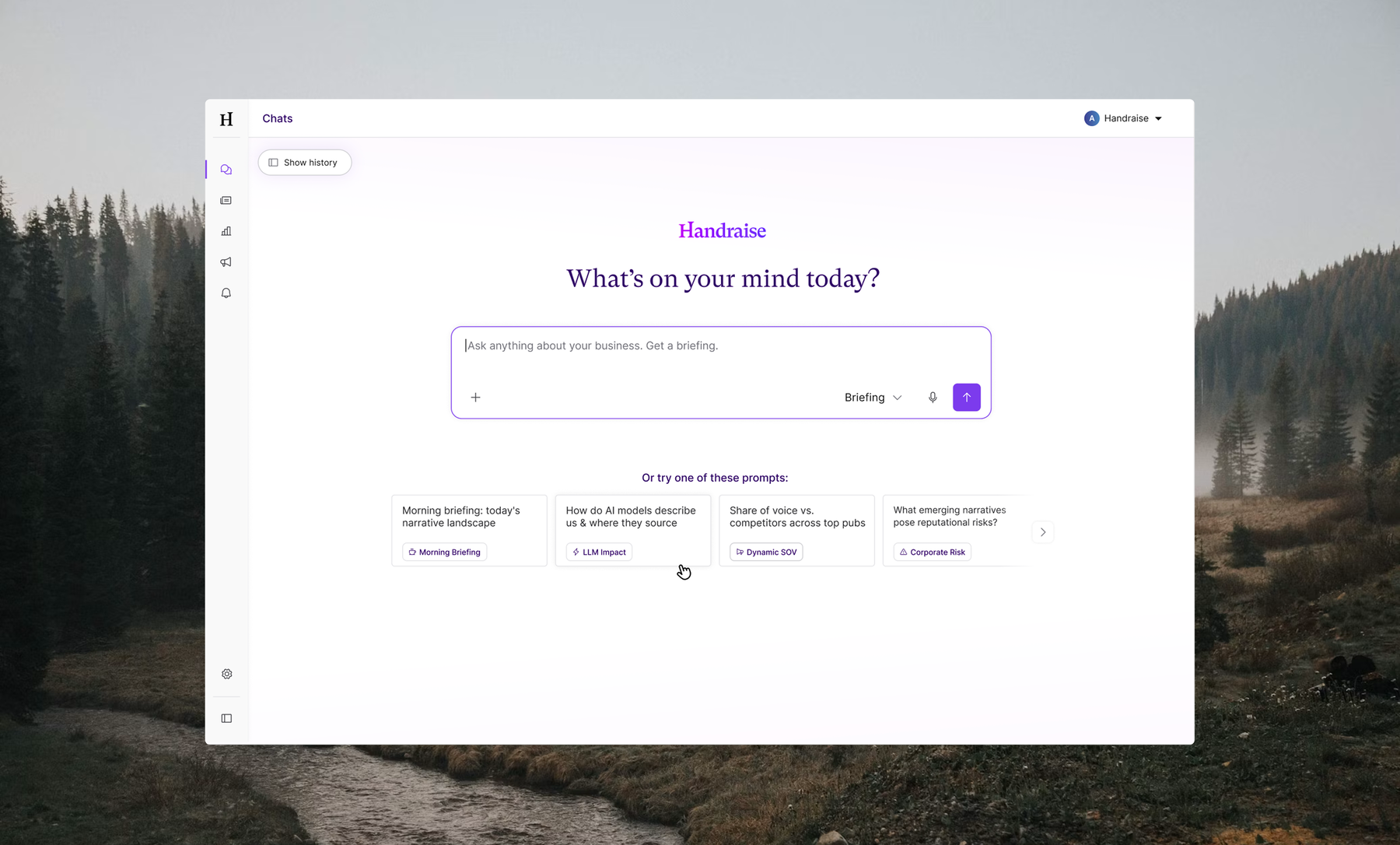
Herald is the AI intelligence partner inside Handraise. It allows communications leaders to ask questions about their business, brand, competitors, industry, coverage, reputation, and AI perception, then receive an accurate, sourced, executive-ready briefing.
It is not another dashboard.
It is not a generic chatbot connected to a media database.
It is an intelligence system built specifically for the decisions modern communications teams make.
Ask Anything About Your Business
Herald gives communications professionals a natural-language interface to the intelligence inside Handraise.
Instead of navigating through multiple dashboards, configuring reports, exporting spreadsheets, and manually synthesizing findings, users can simply ask:
What changed in the last 24 hours that our leadership team should know?
Which narratives about our company are gaining momentum?
Where are competitors outperforming us?
What reputational risks are emerging?
How did the market respond to our announcement?
Which messages are pulling through in coverage?
How are ChatGPT, Claude, Gemini, and Perplexity interpreting this narrative?
Which sources and claims are shaping AI perception?
What should our communications team prioritize next?
Herald does not merely retrieve matching articles.
It interprets the underlying information and produces a briefing designed around the user's question, business context, and intended audience.
That might be a daily executive update, a competitive analysis, a campaign assessment, a risk briefing, an earnings narrative review, an AI perception analysis, or a strategic recommendation for the communications team.
The goal is simple:
Ask anything about your business. Get a briefing. Not a dashboard.
Herald and Herald Thinking
Herald offers two ways to work.
Herald
Herald is designed for fast, high-quality answers to everyday communications questions.
It is ideal for requests such as:
Summarize the most important coverage from today.
Identify the top narratives affecting our company.
Compare our media performance with a competitor.
Explain why this story matters.
Show me how sentiment has changed.
Identify emerging reputational risks.
Prepare a briefing for my CEO.
Herald returns a concise, sourced answer using the intelligence already structured inside the Handraise platform.
Herald Thinking
Herald Thinking is designed for questions that require deeper analysis, more extensive reasoning, or synthesis across larger volumes of information.
It can examine longer time periods, compare multiple narrative clusters, evaluate competing explanations, assess risk signals, analyze stakeholder perception, and develop more detailed strategic conclusions.
Herald Thinking is especially useful for questions such as:
Why has perception of our company changed over the last six months?
Which narratives are most likely to affect our reputation next quarter?
How did this campaign influence both human and AI perception?
What explains the gap between our message strategy and the way we are being covered?
Which competitor narratives are becoming durable market beliefs?
What should we amplify, clarify, counter, or create?
The distinction is not between a basic answer and a smarter answer.
Both modes use the same underlying intelligence system. Herald is optimized for speed and everyday use. Herald Thinking applies more time and reasoning to questions where depth materially improves the result.
Why Herald Is Different From a General-Purpose AI Assistant
Foundation models are extraordinary reasoning engines.
They can summarize information, identify themes, write clearly, compare ideas, and generate useful analysis. But they are not, on their own, reliable enterprise communications systems.
A general-purpose model does not automatically have:
Complete and current coverage about your company
Licensed news and media data
Persistent knowledge of your business priorities
A structured view of your competitors
Your strategic narratives and messages
Accurate brand-centric sentiment
Historical narrative performance
Publication authority and prominence signals
Risk classification built for communications decisions
LLM perception and citation intelligence
Enterprise-grade sourcing, permissions, and auditability
Even when a model can access the open web, it must search, interpret, and reconstruct the relevant context at the moment a question is asked.
That introduces variability.
The model may retrieve incomplete information, overweight a recent article, miss an important narrative, confuse general article tone with sentiment toward the brand, or generate an answer without understanding the company's broader communications strategy.
Herald works differently.
Before the user asks a question, Handraise has already performed much of the analytical work required to answer it correctly.
Intelligence Before the Prompt
Most AI products begin their work after a prompt is submitted.
Herald begins long before that.
The Handraise data platform continuously ingests, enriches, classifies, and structures information about the customer, its competitors, its industry, and the narratives that matter to the business.
Across that process, Handraise makes a large number of precomputed analytical decisions.
Those decisions can include:
Whether an article is truly relevant to the company
Whether the brand is central or only mentioned in passing
How the article positions the brand
Which narrative the article belongs to
Whether the narrative is growing, slowing, hardening, or fading
Which executives, products, competitors, and strategic themes are involved
How prominent the company is within the coverage
Whether the source is authoritative
How widely the story is spreading
Whether the coverage creates an opportunity or risk
How the narrative is likely to influence human perception
How major LLMs interpret the narrative
Which claims and sources are most likely to influence future AI answers
This precomputed intelligence gives Herald a much stronger starting point than a general-purpose model working from raw documents or a live web search.
The model does not need to reconstruct the entire information environment every time a user asks a question.
It can reason over a structured, brand-specific intelligence layer that already understands the company, the coverage, the narratives, and the strategic context.
This improves the quality, consistency, speed, and accuracy of every answer.
The Role of Compaction
Enterprise communications teams may be dealing with thousands or millions of articles, mentions, posts, documents, signals, and data points.
Passing all of that raw information into an AI model is neither efficient nor effective.
More context does not automatically produce a better answer. Unstructured context can dilute the most important evidence, introduce irrelevant details, and make it harder for the model to identify what truly matters.
Handraise uses compaction to turn large volumes of information into a smaller, higher-signal representation that preserves the facts, narratives, relationships, evidence, and strategic meaning required to answer the question.
Compaction is not simply summarization.
A basic summary shortens content.
Compaction preserves the most decision-relevant intelligence across the broader corpus.
It helps Herald understand:
The dominant narratives
The most important factual claims
The strength and direction of the evidence
The sources carrying the greatest authority
The differences between isolated coverage and repeated patterns
The relationship between individual stories and broader reputation outcomes
The context necessary to explain why something matters
This allows Herald to reason across far more information than could practically fit into a single prompt while maintaining the precision needed for executive use.
It is one of the reasons Herald can provide a clear answer without losing the underlying evidence.
Narrative Intelligence, Not Article Retrieval
Traditional media monitoring is organized around individual articles.
Herald is organized around narratives.
An individual article may be important, but reputation rarely forms one article at a time. It forms through repeated stories, claims, themes, and interpretations that accumulate across sources.
Handraise groups related coverage into living narrative clusters, allowing Herald to understand not only what was published, but the larger story taking shape.
That makes it possible to answer more meaningful questions:
Which narratives are gaining momentum?
Which claims are becoming established?
What is driving negative perception?
Where is the company successfully changing the story?
Which competitor narrative is beginning to dominate?
Is a reputational issue isolated, or is it becoming systemic?
Which positive narratives should the company reinforce?
Because Herald can reference narrative-level intelligence, it is not limited to producing article summaries.
It can explain how the information environment is evolving.
Risk Intelligence Built Into Every Answer
Communications leaders cannot afford to treat every negative article as a crisis or every hypothetical concern as an active threat.
Risk analysis requires discipline.
Herald uses Handraise's risk framework to separate what is happening now from what may be developing and what remains speculative.
Depending on the question and depth of analysis, Herald can classify risks using frameworks such as:
Active
Emerging
Potential
Or, in deeper strategic analysis:
Confirmed
Developing
Speculative
This distinction matters.
An active risk should be supported by clear evidence in current coverage.
An emerging risk should be connected to identifiable signals, while clearly stating what remains unconfirmed.
A potential risk should only be elevated when it is relevant to near-term communications decisions, not simply because it is theoretically possible.
Herald can also provide an overall risk posture, such as Low, Moderate, or Elevated, based on the strength, momentum, reach, source authority, and strategic significance of the evidence.
The result is a more accurate view of risk, without unnecessary alarmism or false precision.
Human Perception and LLM Perception
Communications teams are no longer managing reputation only for human audiences.
AI systems increasingly summarize companies, answer questions about brands, compare products, explain controversies, and recommend sources.
Those answers can influence customers, employees, investors, journalists, policymakers, partners, and other stakeholders.
Herald is built to analyze both sides of that information environment.
It can examine how a narrative is being interpreted by human audiences through coverage, positioning, prominence, sentiment, repetition, and source authority.
It can also examine how major LLMs are interpreting the same narrative.
Herald's LLM perception tooling can help communications teams understand:
How ChatGPT, Claude, Gemini, and Perplexity characterize a narrative
Which claims are most likely to become durable AI beliefs
Which sources and articles are shaping model perception
Where AI interpretation differs from the company's intended message
Whether a narrative is likely to improve or weaken future AI answers
Which positive claims should be amplified
Which inaccuracies should be clarified
Which evidence gaps should be filled
Which content should be created or made more authoritative
This is fundamentally different from basic prompt monitoring.
Prompt monitoring begins with a set of guessed questions and repeatedly checks the answers.
Herald begins with the actual narratives shaping the company.
It analyzes the coverage corpus, the claims being repeated, the sources carrying authority, the way models interpret the narrative, and the citations that surface across repeated runs.
That gives communications teams a broader and more strategic understanding of AI perception than a visibility score or a list of prompt rankings.
Answers Grounded in Evidence
The best communications intelligence is not merely persuasive. It is traceable.
Herald grounds its answers in the underlying evidence available through Handraise.
Users can move from an executive conclusion to the narratives, articles, sources, metrics, and signals supporting it.
This is especially important when the output is being used for:
Executive briefings
Board materials
Crisis decisions
Campaign evaluations
Competitive analysis
Earnings preparation
Regulatory or policy issues
Reputation strategy
A confident answer without reliable evidence creates risk.
Herald is designed to provide both.
Built for Communications Workflows
Herald is not a general-purpose productivity assistant adapted to communications.
It was designed around the recurring work of senior communications teams.
That includes:
Daily and weekly executive briefings
Media performance analysis
Narrative tracking
Reputation risk assessment
Competitive intelligence
Message pull-through
Campaign measurement
Event and announcement analysis
Share of voice
Executive visibility
Stakeholder perception
LLM perception
Citation intelligence
Strategic recommendations
The interface may be conversational, but the system behind it reflects the workflows, evidence standards, terminology, and decision-making needs of enterprise communications.
From Information Access to Intelligence
The first generation of media technology digitized clipping.
The next generation added search, dashboards, metrics, and alerts.
Those tools made information easier to access, but they did not eliminate the analytical burden placed on communications teams.
Herald represents the next step.
It turns structured information into intelligence.
It helps teams move from:
Articles to narratives
Mentions to meaning
Sentiment to positioning
Metrics to implications
Monitoring to decision support
AI visibility to AI perception
Dashboards to briefings
The result is not simply a faster way to use media monitoring.
It is a new way for communications leaders to understand and manage the information environment surrounding their business.
The Intelligence Partner for Modern Communications
The role of communications is expanding.
Teams are expected to understand public perception, advise executives, anticipate risk, monitor competitors, interpret complex events, measure outcomes, and increasingly manage how AI systems understand the company.
They need more than tools that organize information.
They need systems that can reason over it.
Herald combines the reasoning power of advanced foundation models with Handraise's proprietary data, precomputed intelligence, narrative architecture, compaction, risk analysis, and LLM perception tooling.
As foundation models improve, Herald improves with them.
But the value does not come from the model alone.
It comes from the intelligence layer around the model: the data, context, structure, evidence, workflows, and brand-specific understanding required to produce answers that communications leaders can actually trust.
That is what we built Herald to deliver.
Ask anything about your business. Get a briefing. Not a dashboard.