
Key takeaways
- Narrative monitoring follows the stories forming around your brand while they're still moving, when a communications team can still change the outcome.
- Mention tracking counts appearances. Narrative tracking follows the storyline those appearances build, including how fast it moves and who is carrying it.
- Six readings carry most of the signal: new storylines, framing drift, tier migration, independent pickup, brand position, and AI pickup.
- The same story moves at different speeds through trade press, national outlets, podcasts, social platforms, and AI assistants.
- AI-assisted clustering makes real-time monitoring work by turning thousands of articles into a short list of storylines.
- Read your five to eight priority narratives every day, and decide now who acts when one of them moves.
Narrative monitoring is the continuous tracking of the stories forming around a brand and its competitors, read at the level of the storyline instead of the individual article. Most PR teams can say how many times the company was mentioned yesterday. Far fewer can tell the CCO which three stories are shaping the company this week and which one is picking up speed.
Stories no longer travel one route. In The Infinite Dial 2026, Edison Research found that 58% of Americans age 12 and older had consumed a podcast in the past month, a record for the survey, and 57% had ever used a generative AI assistant. A claim can start in a trade newsletter, get repeated on a podcast, and surface in an AI answer before anyone sees it on a clip list. Following that movement is the job of communications intelligence for the AI era.
The daily work of tracking those stories is the focus here. Deciding which ones to shape and how belongs to The Complete Guide to Narrative Management.
What Is Narrative Monitoring?
Monitoring at the narrative level means continuously grouping coverage into storylines and tracking each one's size, direction, speed, sources, and how it positions your brand. The unit being watched is a claim or explanation that independent sources keep repeating, such as "the company is falling behind on AI." One article is a data point. Dozens of articles that share the same explanation form a narrative, which stakeholders remember long after the articles themselves.
Where it fits between monitoring and intelligence
Media monitoring finds and delivers coverage, while media intelligence interprets it and recommends what to do. Brand narrative monitoring is the working layer between them. It organizes what monitoring collects into stories and watches those stories move, so interpretation starts from something a person can read in minutes. The full category picture is in The Complete Guide to Media Intelligence.
How Is Narrative Tracking Different From Mention Tracking?
Mention tracking asks how often the brand appeared. Narrative tracking asks what those appearances say together and whether that story is gaining ground. A company can log hundreds of mostly neutral mentions in a month while one critical storyline subtly moves from trade outlets into the business press. A mention count buries that story among hundreds of routine articles, while a narrative view puts it at the top of the list.
| Mention tracking | Narrative tracking | |
|---|---|---|
| Unit watched | One appearance in one article | A storyline repeated across sources |
| Core question | How often were we mentioned? | What story is forming, and is it growing? |
| Typical alert | Volume spike or keyword match | New storyline, framing shift, or tier move |
| Built on | Keyword and Boolean strings | AI grouping of coverage by meaning |
| Leadership receives | Counts and clip lists | The few stories that matter, with a next step |
Counting mentions still matters because every narrative view is built from the coverage monitoring collects. The article on Media Intelligence vs. Media Monitoring explains when each layer is the right tool.
Which Signals Matter Most in Brand Narrative Monitoring?
The signals that matter most are new storylines, framing drift, tier migration, independent pickup, brand position, and AI pickup. Read all six on every priority storyline at each review because no single signal settles anything alone.
New storylines. A cluster of coverage that didn't exist last week. Most fade within days, and the ones worth attention quickly gather independent sources.
Framing drift. "Shipping delays" becoming "management misjudged demand" is the same topic with a far more damaging story attached.
Tier migration. The story moves from niche or trade outlets into publications that investors or regulators read.
Independent pickup. Twenty syndicated copies of one wire story are distribution. Five newsrooms reporting it themselves are corroboration.
Brand position. Whether the company is the subject or a passing reference, measured with brand-centric sentiment rather than the tone of the topic.
AI pickup. The framing appears when AI assistants are asked about the company or its category, a sign that it has enough published support to persist.
When a single spike needs qualifying before anyone escalates it, the tests in How to Separate Signal From Noise apply.
How Do You Measure Narrative Velocity and Spread?
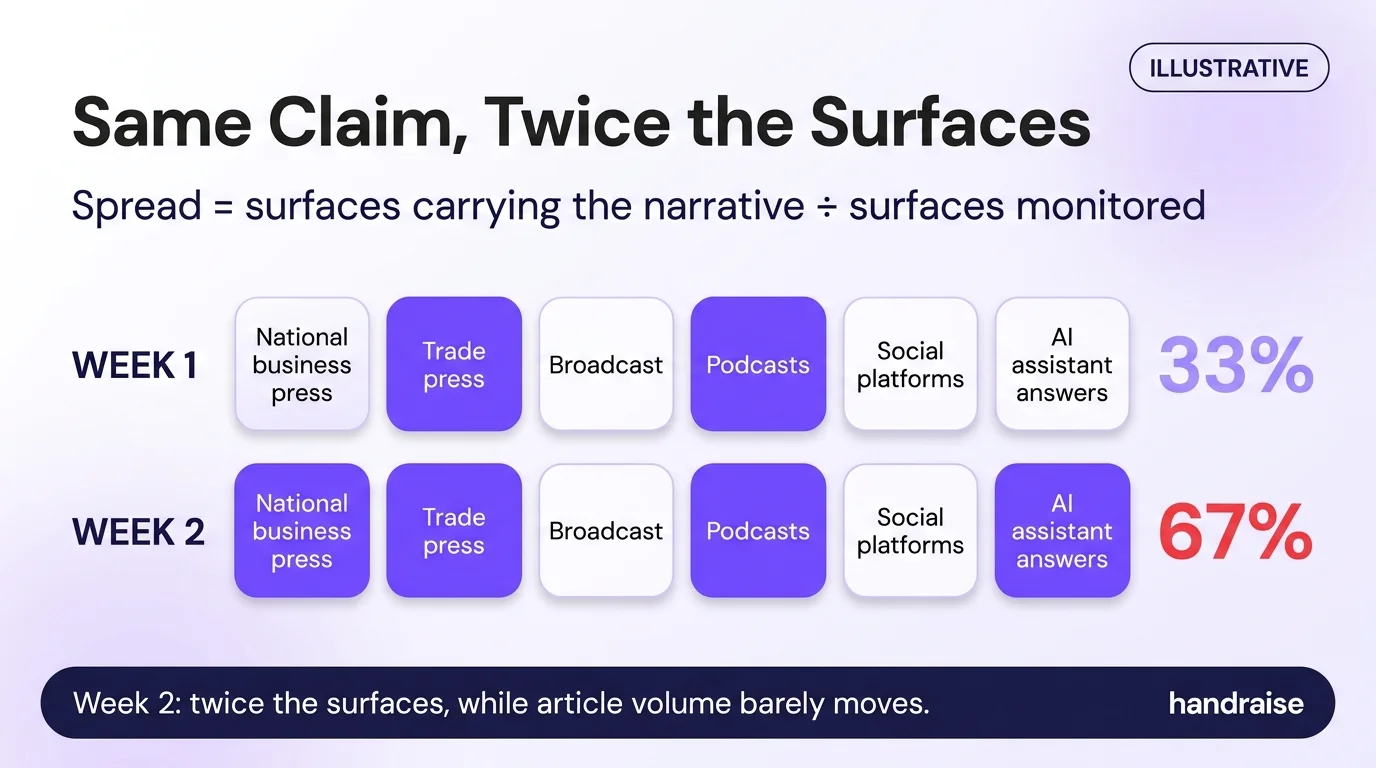
Measure velocity as the rate at which a narrative gains independent sources and credibility, and measure spread as the share of monitored surfaces carrying it. Velocity has its own stages and response guidance, covered in The Early Signal of Reputation Risk. Spread is simpler to track and easier to overlook.
Suppose a team monitors national business press, trade press, broadcast, podcasts, social platforms, and AI assistant answers. One product reliability claim appears on two of them in week one (33%). By week two, it shows up on four (67%) while article volume barely moves, so the team checks which new outlets and channels picked it up.
Why Do Sources and Audiences Change What You See?
Each surface carries a story to a different audience, at a different speed, with different staying power. Media narrative monitoring watches these surfaces side by side because surprises come from the gaps between them.
| Surface | Who it reaches | How narratives behave |
|---|---|---|
| National and business press | Executives, investors, policymakers | Slower to start, highly credible once there |
| Trade and industry press | Buyers, partners, specialists | Often where specific claims first appear |
| Broadcast | Broad public audiences | Amplifies stories established elsewhere |
| Podcasts | Engaged niche and professional listeners | Long-form discussion that travels through clips |
| Social platforms | Public and employee conversation | Fast, emotional, often short-lived |
| AI assistants | Anyone asking about your company | Repeats what published coverage supports |
Tag every narrative by the surfaces it occupies, and treat movement from one surface to another as a signal in its own right.
How Do You Catch Emerging Risk Before It Peaks?
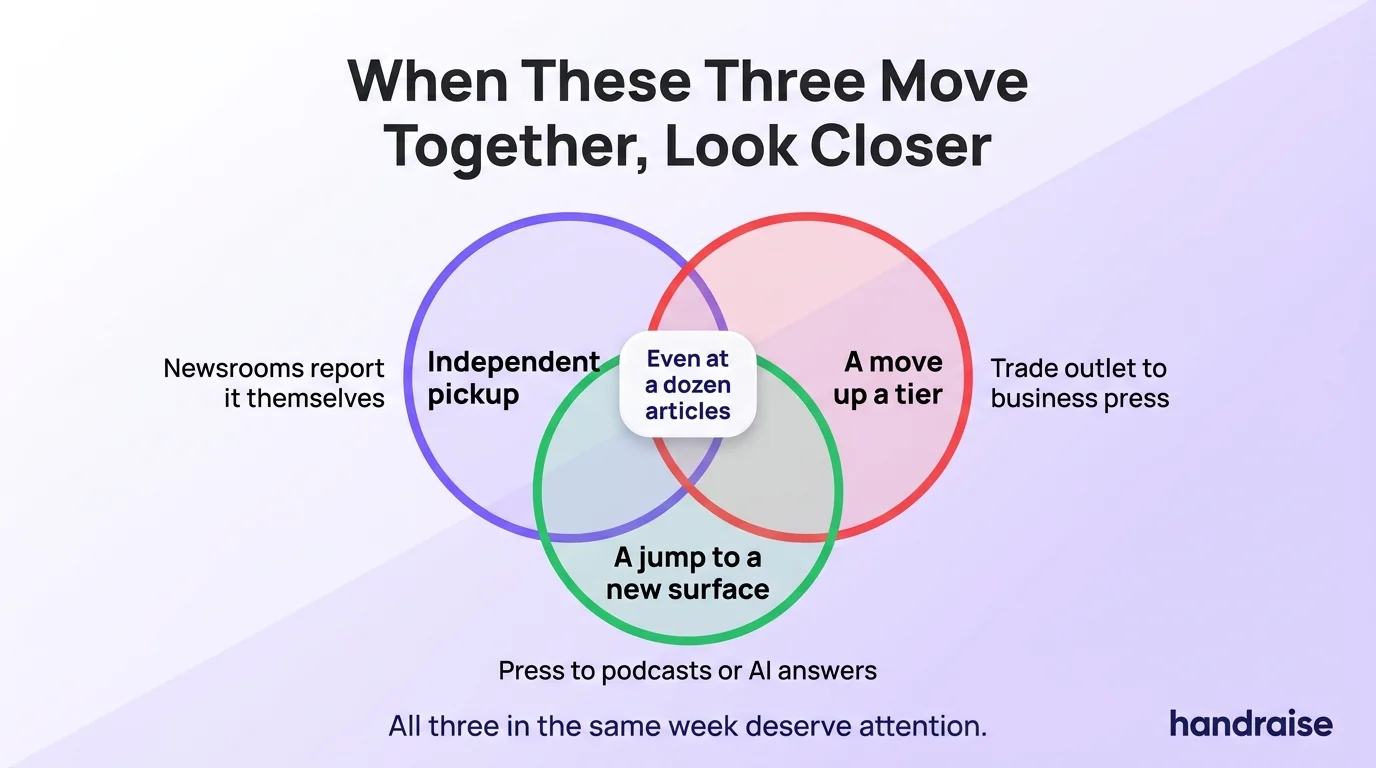
Catch emerging risk by watching for several signals that move in the same week while volume is still low. Independent pickup, a move up a tier, and a jump to a new surface together deserve attention, even at a dozen articles. That combination is where real-time narrative monitoring pays off. All three readings can change well inside a quarterly reporting cycle.
An illustrative example: a quiet claim crossing tiers
Consider a composite case. A medical device maker's monitor flags a storyline in two trade newsletters suggesting the company was slow to explain a product correction. By day three, a third outlet has reported it independently, an industry podcast has discussed it, and when asked about the company, an AI assistant mentions questions about its recall communication. There are 11 articles in total, so the volume alert never fires, yet the team briefs the CCO with facts and a corrected timeline before national reporters call.
How Should You Monitor Competitor Narratives?
Competitor narratives belong in the same monitor as your own because the stories about rivals define the comparison customers and investors make. Track the storylines that decide your category, then note who leads each one and which remain unclaimed. A competitor becoming "the safer choice" in trade coverage is a signal about your position even when your name never appears. Dynamic Share of Voice at the narrative level makes this concrete, and the scorecard method is laid out in How Your Brand Story Compares.
How Does AI Narrative Monitoring Work?
AI automatically groups coverage into storylines, which makes real-time monitoring practical. AI assistants have also become a surface the monitor has to watch because stakeholders now ask them about companies directly.
Clustering replaces keyword strings
Grouping coverage by hand means reading hundreds of articles and deciding which belong together. AI clustering reads each article for meaning, so no Boolean string has to anticipate every phrasing.
A March 2026 study led by University of Washington researchers modeling narratives as evolving structures across a real crisis without predefined labels found that some narratives are short-lived fragments while others become stable anchors. Telling those two apart early is what narrative intelligence monitoring is for, and every storyline should link back to its source articles so a person can check it.
AI assistants are now a surface to watch
On Alphabet's Q3 2026 earnings call, CEO Sundar Pichai said the Gemini app had reached one billion users and that AI Mode queries run about three times longer than traditional searches. Those fuller answers draw on the narratives that dominate published coverage.
In communications terms, a citation is earned media the AI repeats, and an assistant's description of your company is reputation exposure your clip list never shows. AI narrative monitoring tracks how assistants describe priority storylines and which sources they lean on. No team can edit those answers, but it can see early when an assistant starts repeating a framing.
What Does a Real-Time Monitoring Workflow Look Like?
A real-time workflow starts with a short list of priority narratives, gives each one an owner and a reading cadence, and reports direction to leadership. Skipping any of those steps causes the work to drift back to circulating a daily list of articles, no matter how good the software is.
Define the narratives and their surfaces
Start with five to eight priority narratives tied to this year's strategy, plus the category storylines where competitors lead. List every surface where each one could appear. Include AI assistant answers, and keep everything else in the background until its readings change.
Set a cadence and an owner
Each priority narrative needs a named owner who decides how far a change should travel, from a note in the log to a same-day brief for the CEO. Agency partners work best with access to the same view, so their outreach targets the stories that most need to move. The rhythm below keeps the habit alive during busy weeks.
Recommended cadence
Alerts on tier migration and AI pickup, a 15-minute narrative read each morning, a weekly review of all storylines, and a quarterly reset of priorities.
Report direction, not volume
A leadership update should name the narrative and its direction, then end with a recommendation or a plain "no action needed." Keep it to about two minutes of reading. Monitoring that feeds decisions this way is what media intelligence built around narratives is meant to deliver.
What Belongs on a Narrative Monitoring Checklist?
Use this list to audit an existing program or set up a new one. If more than two items are missing, the program is likely counting mentions under a narrative label.
Five to eight priority narratives, written as one-sentence storylines
Competitor and category narratives tracked alongside your own
Coverage grouped automatically, with every storyline linked to its sources
Syndicated copies separated from independent reporting
Publication tiering and brand-centric sentiment on every article
Velocity and spread recorded at every review
AI assistant answers checked for priority narratives
Escalation thresholds and named owners set in advance
Frequently asked questions
Media monitoring finds and delivers individual pieces of coverage. Monitoring at the narrative level groups that coverage into storylines and tracks how each one changes over time, including how it positions the brand. Most enterprise teams need both.
Priority narratives should be read daily, with alerts for tier or AI movement in between. A weekly review covers the full set, including competitors. Quarterly is too slow to be the first time leadership hears about a story.
Yes. AI clustering groups coverage by meaning, so a team doesn't have to anticipate every phrasing in a keyword string. Boolean queries can still help define scope.
Yes. AI assistants summarize published coverage when people ask about a company, so a narrative's framing can surface in their answers. Monitoring shows how they describe priority narratives and which sources they cite, though it cannot edit those answers.
Watch the Stories Behind the Mentions
The teams that handle reputation well tend to see a story before it has a name. They read a short list of narratives every day, notice when one reaches a bigger outlet or a new channel, and act while the facts can still shape the outcome.
Handraise was built for this work by the team behind TrendKite, using patented Narrative Clusters™, publication tiering, brand-centric sentiment, and AI perception tracking to show how your narratives are moving across media and AI. Book a briefing to see which stories are forming around your brand right now.