Blog
Insights
Straightforward interfaces make navigation and actions more intuitive, reducing the learning curve for new users.

Matt Allison
Founder & CEO

Key Takeaways
Your brand's reputation is forming across dozens of channels simultaneously—and most teams are only watching a fraction of them.
Traditional media monitoring tools track individual mentions but miss the narrative patterns that actually shape perception.
A meaningful reputation score requires pulling together earned media sentiment, share of voice, publication authority, and AI perception—not just clip counts.
Corporate reputation tracking in a fragmented landscape demands real-time intelligence, not quarterly reports that arrive after the story has already been told.
Teams that shift from reactive monitoring to proactive narrative management will lead; those relying on legacy tools will always be playing catch-up.
The question isn't whether you're monitoring your brand—it's whether you're measuring what actually shapes its reputation.
The places where your brand's story lives and evolves have multiplied dramatically. News sites, podcasts, newsletters, social channels, Reddit threads, AI-generated responses—each is a distinct channel producing its own signals about how your brand is perceived. According to Nielsen's research on media consumption and fragmentation, audience attention is no longer concentrated in a handful of predictable spaces. It flows continuously across a wide array of platforms, and the old model of tracking a few key outlets to understand brand perception simply doesn't hold anymore.
The demand for better answers has created an industry. The global media monitoring tools market was valued at over $5 billion in 2024 and is projected to reach $12 billion by 2030—a signal that enterprises are investing heavily in this capability. But market growth alone doesn't solve the core problem: having more tools doesn't automatically mean having better intelligence.
This creates a fundamental challenge for communications leaders: how do you build a brand reputation monitoring practice across channels that never stop producing signals—one that surfaces real insight rather than more noise? How do you turn fragmented data into a reputation score you can act on? That's what next-generation reputation platforms are designed to solve—and what this guide will walk you through.
What Does Brand Reputation Monitoring Actually Mean Today?
The term gets used loosely, so it's worth grounding. Brand reputation monitoring, at its core, is the practice of systematically tracking how your brand is perceived across earned media, social platforms, and increasingly, AI-generated content—then using that intelligence to make strategic decisions.
Today, it means something more sophisticated: understanding the narratives forming around your brand, how sentiment is trending within specific storylines, which publications carry enough authority to shape downstream perception, and how AI systems—which millions of people now query daily—are characterizing your company when asked.
Corporate reputation tracking has had to expand accordingly. The old inputs (clips, impressions, AVE) are giving way to richer signals: brand-centric sentiment that accounts for how prominently your brand features in a story, publication tiering based on domain authority and reach, and narrative clusters that group related coverage into themes rather than treating every article as a standalone data point.
The result is a fuller picture—one that supports strategic decisions rather than just retrospective reporting.
Why Fragmentation Complicates Everything
The fragmented media landscape is the context that makes all of this harder. When audience attention was concentrated in a few dominant channels, tracking reputation was manageable. You monitored the major outlets, tracked a handful of social platforms, and had a reasonable view of how your brand was being discussed.
That world no longer exists. Streaming has disrupted traditional broadcast. Social media platforms have proliferated. Newsletters, podcasts, and niche communities have grown into serious influence channels. And now AI systems—ChatGPT, Gemini, Perplexity, and others—synthesize coverage from across the web and present it as authoritative answers, adding an entirely new layer to the reputation equation.
Each channel has its own tone, cadence, and audience. Each surfaces different signals about brand perception. And without a unified framework for pulling these signals together and weighting them appropriately, your analysis stays fragmented even if your monitoring coverage is broad.
How to Build a Meaningful Reputation Score
A reputation score needs to do one thing well: translate complex, multi-channel data into a single, actionable signal. When built correctly, it tells your team at a glance how your brand is performing and where attention is needed.
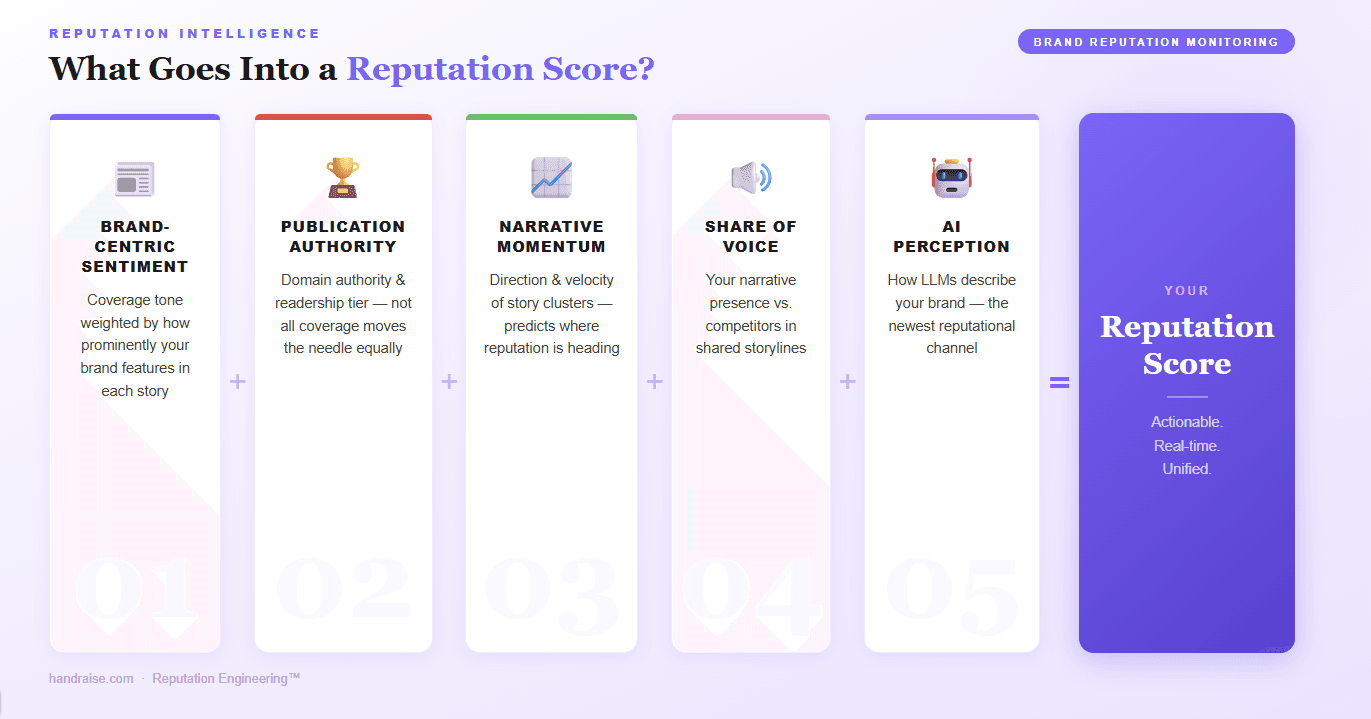
Here are the core inputs that should factor into any credible reputation score for enterprise communications teams:
Input | What It Measures | Why It Matters |
Brand-centric sentiment | Tone of coverage specific to your brand's role in each story | Distinguishes meaningful mentions from passing references |
Publication authority | Domain authority and readership of covering outlets | Not all coverage is equal—tier matters |
Narrative momentum | Direction and velocity of key story clusters | Predicts where reputation is heading, not just where it's been |
Share of voice | Your narrative presence vs. competitors in shared storylines | Context for whether you're winning or losing the story |
Social amplification | How many times covered stories are shared | Extends impact measurement beyond the article itself |
AI perception | How LLMs describe your brand when queried | The newest and fastest-growing reputational channel |
The key principle: no single metric tells the full story. A brand might have high media volume but poor brand-centric sentiment. It might dominate traditional press but be underrepresented—or misrepresented—in AI-generated responses. A holistic reputation score accounts for all of these dimensions and weights them based on strategic priority.
Calculating Your Baseline
Before you can track movement, you need a baseline. Start by auditing the past 90 days of coverage across your primary channels. Look at:
Sentiment distribution — across all coverage, what percentage is positive, neutral, or negative? More importantly, what's the sentiment within your highest-impact narratives?
Share of voice — in the storylines most relevant to your business, how prominently does your brand feature compared to competitors? Where are you leading? Where are you losing ground?
Publication tier breakdown — of the outlets covering your brand, how many are tier-one publications (high domain authority, large readership) versus lower-authority sources? A lot of coverage from low-authority sites may not move the needle the way a few pieces in top-tier outlets can.
Narrative clusters — group your coverage by theme, not just volume. What are the three to five primary stories forming around your brand? How is sentiment trending within each?
This baseline becomes the foundation for ongoing corporate reputation tracking. Monthly or weekly comparisons reveal trajectory—and trajectory is ultimately what reputation management is about.
The Channels That Demand Attention in 2026
Most communications teams have a handle on the obvious channels—major publications, Twitter/X, LinkedIn. But brand reputation monitoring in a fragmented landscape requires coverage that extends beyond the usual suspects.
Earned media (traditional and digital press) remains the core. It carries the most authority and feeds into AI systems more heavily than other source types. Here, the critical distinction is prominence: was your brand the headline, or a passing mention? That context dramatically affects reputational impact.
Social media surfaces sentiment signals quickly—often before traditional press coverage picks it up. The challenge is noise. Volume is high, relevance varies, and tracking narrative formation (rather than individual posts) requires AI-powered analysis to be feasible at scale. The PR analytics needed by senior leadership increasingly reflect this complexity.
Niche platforms and communities — Reddit, industry forums, Substack newsletters, podcasts — have grown significantly in influence among specific audiences. A negative thread on a high-traffic subreddit can shape perception among a targeted group far more powerfully than a brief trade press mention.
LLMs and AI search represent the newest layer of brand reputation monitoring—and the one most teams are least prepared for. When a prospective customer, journalist, or investor queries an AI system about your company, the response they receive is shaped entirely by the narratives those systems have absorbed from the web. A negative or inaccurate narrative can become embedded in AI responses and persist far longer than it would in traditional news cycles.
This is why narrative monitoring and optimization—ensuring that the stories forming around your brand are accurate, complete, and favorable—has become a strategic priority, not just a tactical one.
The AI Perception Layer
Understanding how LLMs perceive and describe your brand is a fundamentally different discipline than tracking press coverage. It requires analyzing what narratives exist in the media ecosystem that AI systems are drawing on, identifying gaps or inaccuracies in how your brand is characterized, and then working to shift the underlying narrative landscape so that AI-generated responses reflect your brand more accurately.
As detailed in our exploration of narrative management and proactive reputation shaping, a negative storyline that gets picked up by AI systems doesn't fade from headlines—it can become how machines describe your brand for months. That represents a new accountability layer for communications leaders that the old monitoring paradigm doesn't address.

From Data to Decision: What Good Narrative Monitoring Looks Like
Collecting reputation data is only valuable if it enables better decisions. The gap between having information and using it strategically is where most communications teams struggle.
Here's what effective narrative monitoring looks like in practice:
Real-Time Visibility Into Narrative Formation
Rather than compiling weekly or monthly reports, effective corporate reputation tracking surfaces emerging storylines as they form. This means flagging narrative clusters gaining momentum—groups of related articles that together signal a developing story—before they reach mainstream coverage. Teams that catch a narrative early can shape it; teams that catch it late are left reacting.
The shift from quarterly analysis cycles to real-time intelligence isn't just a speed upgrade. It's a strategic transformation. When your team has current data, they can brief executives in advance of analyst calls, respond to journalists before a story hardens into a negative frame, and adjust messaging before a competitor narrative takes hold.
Competitive Share of Voice
Your reputation doesn't exist in isolation—it's always relative to how competitors are being covered in the same storylines. Tracking dynamic share of voice shows you not just your own narrative position, but where competitors are gaining ground, where they're vulnerable, and where your team has an opportunity to claim favorable positioning.
This is particularly valuable in industries where your brand frequently appears in comparison coverage. Knowing which narratives your competitors are winning—and why—is essential to outmaneuvering them strategically.
Connecting Coverage to Impact
One of the persistent challenges in tracking brand reputation has always been connecting media activity to business impact. Clip counts and impression numbers don't resonate with CFOs or boards. What does resonate is showing how narrative movement correlates with shifts in stakeholder perception, customer sentiment, and competitive positioning over time.
As explored in the context of how media intelligence improves PR strategy, advanced platforms connect earned media intelligence to measurable shifts in brand-centric sentiment—making the business case for communications investment far more compelling.
Common Mistakes in Corporate Reputation Tracking
Even teams with significant resources routinely make mistakes in how they approach reputation tracking. Here are the most consequential ones:
Treating all coverage as equal. A headline feature in a tier-one publication and a passing reference in a low-authority blog are not the same thing. Brand reputation monitoring without publication tiering produces misleading picture of your media footprint.
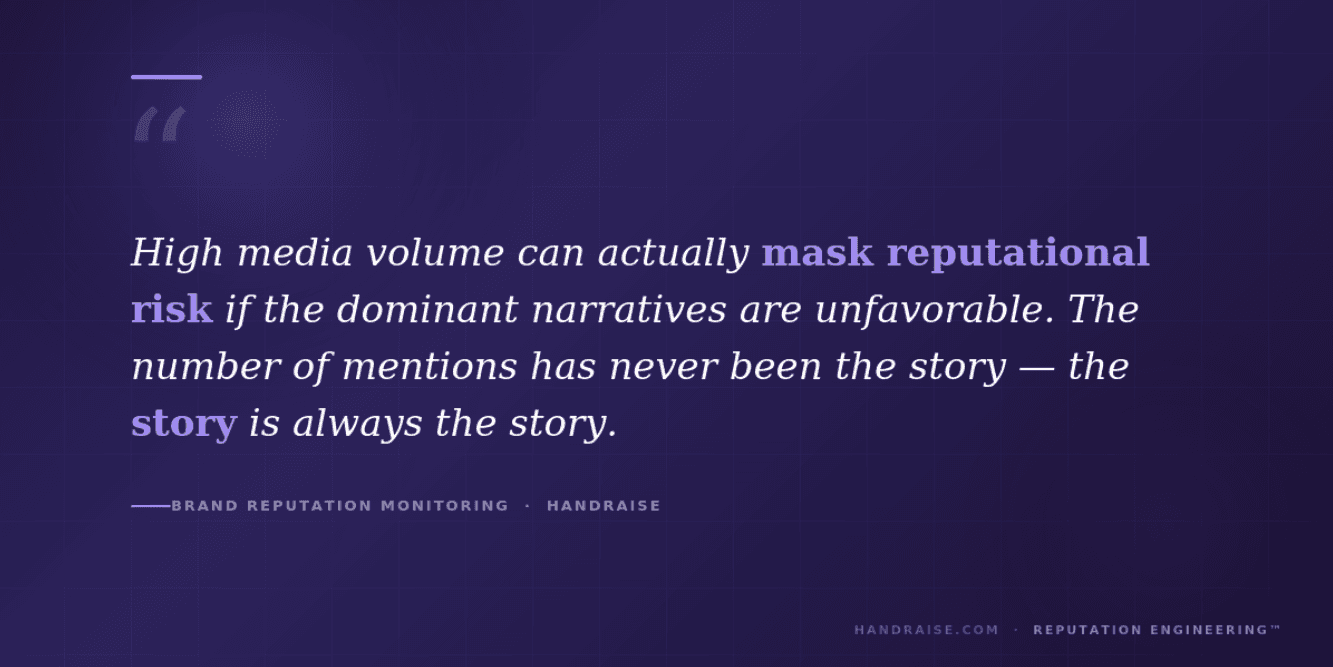
Measuring volume, not narrative. High media volume can actually mask reputational risk if the dominant narratives are unfavorable. Teams focused on mention counts miss the qualitative dimension that actually drives perception.
Ignoring the AI layer. With AI search adoption accelerating rapidly, brands that aren't monitoring or optimizing for LLM perception are leaving a major reputational channel unmanaged. The rise of narrative clusters and their role in AI-era reputation explains why the stakes here are rising fast.
Waiting for the quarterly report. By the time a quarterly analysis is complete, the narratives it describes are often already resolved—or have caused damage that's done. Real-time intelligence replaces the retroactive report with continuous, actionable visibility.
Siloed analysis. Tracking earned media separately from social, and both separately from AI perception, produces an incomplete picture. Effective corporate reputation tracking integrates signals across channels into a unified view.
Reputation Score Benchmarking: A Reference Framework
How do you know if your reputation score is strong? Context matters. Here's a framework for thinking about benchmarks across key dimensions:
Reputation Dimension | Signals of Strength | Signals of Risk |
Sentiment balance | 70%+ positive across tier-one coverage | Negative narratives dominating high-authority outlets |
Narrative momentum | Brand featured in favorable, growing storylines | Brand absent or reactive in key industry narratives |
Share of voice | Leading or pacing with competitors in core topics | Competitors dominating shared narrative space |
Publication tier | Strong presence in tier-one outlets | Coverage concentrated in low-authority sources |
AI perception | Brand accurately represented in LLM outputs | Outdated, inaccurate, or competitor-favorable AI responses |
These aren't absolute thresholds—every industry and competitive context is different. But they provide a starting framework for evaluating where your brand stands and where attention is most needed. The complete guide to modern PR measurement goes deeper on how to translate these signals into executive-ready reporting.

Frequently Asked Questions
What is a brand reputation score, and how is it calculated?
A reputation score is a composite metric that combines multiple data inputs—sentiment, share of voice, publication authority, narrative momentum, and increasingly, AI perception—into a single indicator of brand health. There's no universal formula; the weighting of inputs should reflect your organization's strategic priorities. The goal is a score that tracks trajectory over time and surfaces where attention is needed, rather than a fixed benchmark.
How often should we be monitoring brand reputation?
In a fragmented, fast-moving media environment, continuous monitoring is the standard. Real-time or near-real-time narrative tracking allows teams to respond to emerging stories before they harden into fixed frames. Weekly synthesis of that data into strategic insights—covering narrative trends, sentiment shifts, and competitive share of voice—supports executive briefings and campaign planning.
What's the difference between media monitoring and narrative monitoring?
Media monitoring tracks where and when your brand is mentioned. Narrative monitoring goes further, grouping related coverage into thematic clusters to reveal what story is forming—and whether it's moving in a direction favorable to your brand. Narrative monitoring asks "what's the story?" where media monitoring asks "where were we mentioned?"
How do AI platforms factor into reputation monitoring?
AI systems like ChatGPT, Gemini, and Perplexity now serve as information sources for millions of users. When they answer questions about your brand, their responses are shaped by the narratives present in the media they've been trained on or can access. Brands that don't monitor AI perception—or optimize their narrative landscape to influence it—are ceding control of a major and growing reputational channel.
Start Engineering Your Reputation—Don't Just Monitor It
Brand reputation monitoring has evolved from a tactical function into a strategic capability. In a fragmented media landscape, the teams that will outperform are those treating reputation as a living system to be actively managed—not a report to be compiled after the fact. They're tracking narrative formation in real time, measuring share of voice dynamically, accounting for AI perception as a distinct and critical channel, and connecting all of it to a reputation score that drives strategic decisions.
This is exactly what Handraise was built to deliver. The platform moves beyond legacy monitoring—powered by patented narrative clustering technology, brand-centric sentiment analysis, publication tiering, and LLM impact tracking—to give enterprise communications leaders the real-time intelligence they need to engineer reputation, not just observe it. Book a demo to see how it works.
Matt Allison
Founder & CEO
Share