Blog
Insights
Straightforward interfaces make navigation and actions more intuitive, reducing the learning curve for new users.

Matt Allison
Founder & CEO

Key Takeaways
Competitive advantage in communications belongs to teams that move on narratives before they solidify—not to those who analyze last quarter's data.
Modern communications intelligence goes beyond tracking mentions; it maps the narrative landscape around your brand and your competitors in real time.
Share of voice without narrative context is a vanity metric—knowing what stories are gaining ground is what drives smart strategic response.
Brand benchmarking against competitors requires clean, structured, enriched data—not a dump of Boolean search results.
Communications leaders who invest in competitive narrative tracking stop playing defense and start shaping outcomes.
If your current tools only tell you what was said, it's time to demand intelligence that tells you what it means—and where it's heading.
Every communications leader has felt the frustration: you get a stack of coverage data, spend weeks sorting through it, build a report, and by the time it lands in the boardroom, the news cycle has moved on. The story that threatened your brand last month is already baked into industry perception. Your competitors, meanwhile, have pivoted and moved forward.
That frustrating lag is the core problem that media intelligence was built to solve. But this category has evolved considerably over the past few years—and how you apply it to competitive analysis can be the difference between leading a narrative and chasing it.
This post breaks down what a modern media intelligence strategy actually looks like in practice, how it fuels real competitive analysis, and what communications teams at the enterprise level need to do differently to stay ahead. According to the USC Annenberg Global Communication Report, communications functions are under increasing pressure to demonstrate strategic value—meaning the quality of your intelligence infrastructure has never mattered more.
What Is Media Intelligence—and Why It's Not Just "Monitoring"
There's a meaningful distinction between media monitoring and narrative intelligence that gets glossed over in a lot of vendor conversations. Monitoring is about collection: pulling in articles, posts, and mentions that match your Boolean search terms. Intelligence is about interpretation: understanding what the coverage actually means for your brand, your strategy, and your competitive position.
Traditional media monitoring tools were designed for a simpler media environment. You built keyword strings, pulled in results, and manually sorted the relevant from the irrelevant. That process was slow, error-prone, and deeply dependent on how well your team could write Boolean logic. The data that came out the other end was often messy, incomplete, or padded with results no one actually needed.
Modern intelligence platforms take a different approach. Instead of raw keyword matching, AI-powered systems analyze content semantically—understanding context, relevance, and prominence. An article that mentions your brand in a headline carries different weight than one that buries your company name in paragraph fourteen. A story that's been shared 40,000 times across social platforms has a very different impact profile than one that ran in a regional trade publication. True intelligence platforms account for all of that before the data ever reaches your dashboard.
From Data Points to Narrative Clusters
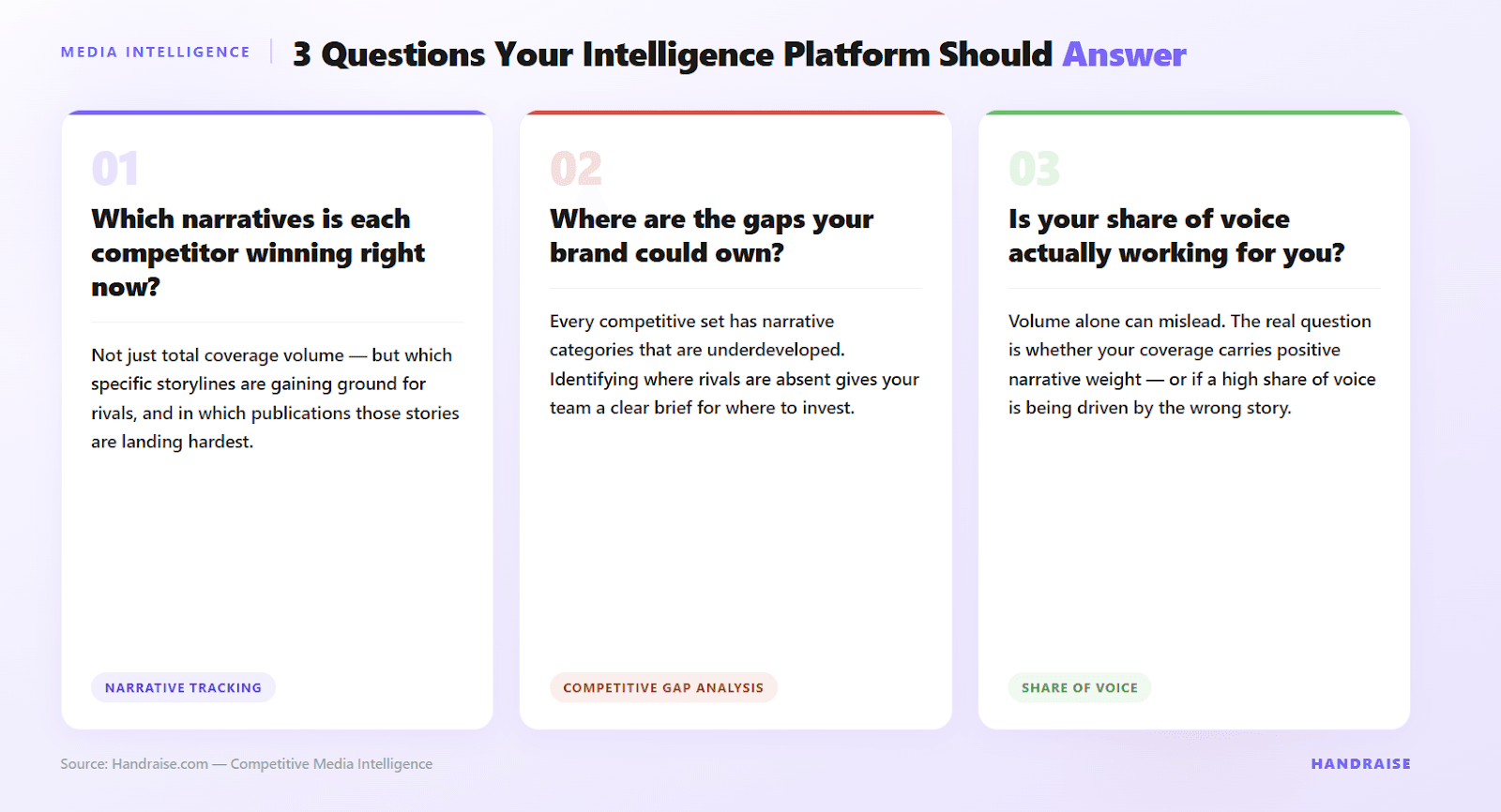
The most significant leap forward in narrative intelligence strategy isn't faster data collection—it's the ability to group coverage into coherent narratives. Rather than seeing 200 individual articles, communications leaders can see that those 200 articles represent five distinct storylines: one around product leadership, one around an industry controversy, two that favor competitors, and one that's emerging and hasn't fully formed yet.
That narrative-level view changes the nature of competitive analysis entirely. Instead of asking "how much coverage did we get compared to Brand X?", you start asking "which narratives is Brand X winning, and what's driving their momentum in that space?" Those are the questions that actually inform strategy.
How Does Competitive Media Intelligence Actually Work?
Competitive media intelligence is the practice of systematically tracking, analyzing, and interpreting media coverage across your brand and your key competitors to understand relative positioning, narrative strength, and share of voice over time.
The keyword there is systematically. Most enterprise communications teams are doing some version of competitor tracking—Google alerts, manual scans, periodic agency reports—but few are doing it in a way that produces actionable intelligence at the speed modern communications require. Tracking share of voice manually across a competitive set of four to six brands, across dozens of publications, updated weekly, is simply not feasible without the right infrastructure.
Effective competitive intelligence programs involve a few core components:
Coverage volume and velocity — How much coverage is each brand receiving, and is it accelerating or slowing? Volume alone doesn't tell you much, but volume trends relative to competitors can signal momentum shifts before they become obvious.
Publication tiering and reach — Not all coverage is equal. A mention in a top-tier national business outlet carries far more narrative weight than a pickup in a low-domain-authority trade blog. Competitive analysis that doesn't account for publication quality will always produce distorted results.
Sentiment and narrative framing — Which brands are being discussed favorably, and in what contexts? More importantly, which narratives are driving positive and negative sentiment? This is where brand benchmarking moves beyond surface metrics and into genuine strategic intelligence.
Share of voice by narrative — The most sophisticated competitive teams are tracking not just overall share of voice, but share of voice within specific narrative categories. You might be winning overall coverage volume but losing the leadership narrative to a key competitor—and that's the insight that matters.
Why Real-Time Data Changes the Game
Legacy competitive analysis was almost always retrospective. Reports summarized what happened last quarter. By the time stakeholders saw the data, the window for strategic response had long closed. A real-time intelligence platform flips that dynamic.
When you can see a competitor narrative gaining momentum in the first 48 hours—before it crosses into mainstream coverage—you have options. You can respond, redirect, accelerate your own counter-narrative, or engage proactively with the journalists and publications driving the story. Those options disappear when your intelligence cycle runs on a quarterly cadence. For a deeper look at why real-time narrative tracking matters for communications leaders, it's worth understanding the mechanics behind how narratives spread and solidify.

Brand Benchmarking: What Meaningful Competitive Comparison Looks Like
Brand benchmarking in communications has historically been a fairly shallow exercise—count your mentions, count a competitor's mentions, calculate a percentage, declare a winner. That approach produces numbers but rarely produces insight. In fact, Ragan's 2024 Communications Benchmark Report found that lack of time and lack of proper technology ranked as the top two measurement challenges among communicators—which explains why so many teams produce reports that arrive too late to influence anything.
A more effective approach to competitive intelligence starts with a richer data model. Here's what separates surface-level benchmarking from strategic intelligence:
Metric | Traditional Benchmarking | Narrative-Driven Benchmarking |
Coverage Volume | Total mentions | Mentions by narrative cluster |
Sentiment | Positive/Negative/Neutral % | Sentiment by topic and context |
Share of Voice | % of total coverage | Share by publication tier and narrative |
Trend Analysis | Monthly or quarterly | Real-time, with momentum signals |
Competitive Positioning | Static snapshot | Dynamic—shifts tracked as they happen |
Insight Output | "We got X% more coverage" | "Competitor is winning the sustainability narrative in Tier 1 outlets" |
The difference in strategic utility between those two columns is enormous. A report that tells you your share of voice dropped three points last quarter gives you a problem. A system that shows you which competitor narrative gained ground, in which publications, and why gives you a path forward.
The Share of Voice Trap
Share of voice is one of the most cited—and most misunderstood—metrics in competitive communications. It's typically expressed as a percentage of total media coverage in a given competitive set. A brand with 35% share of voice in its category sounds like it's in a healthy position. But share of voice without narrative context can be deeply misleading.
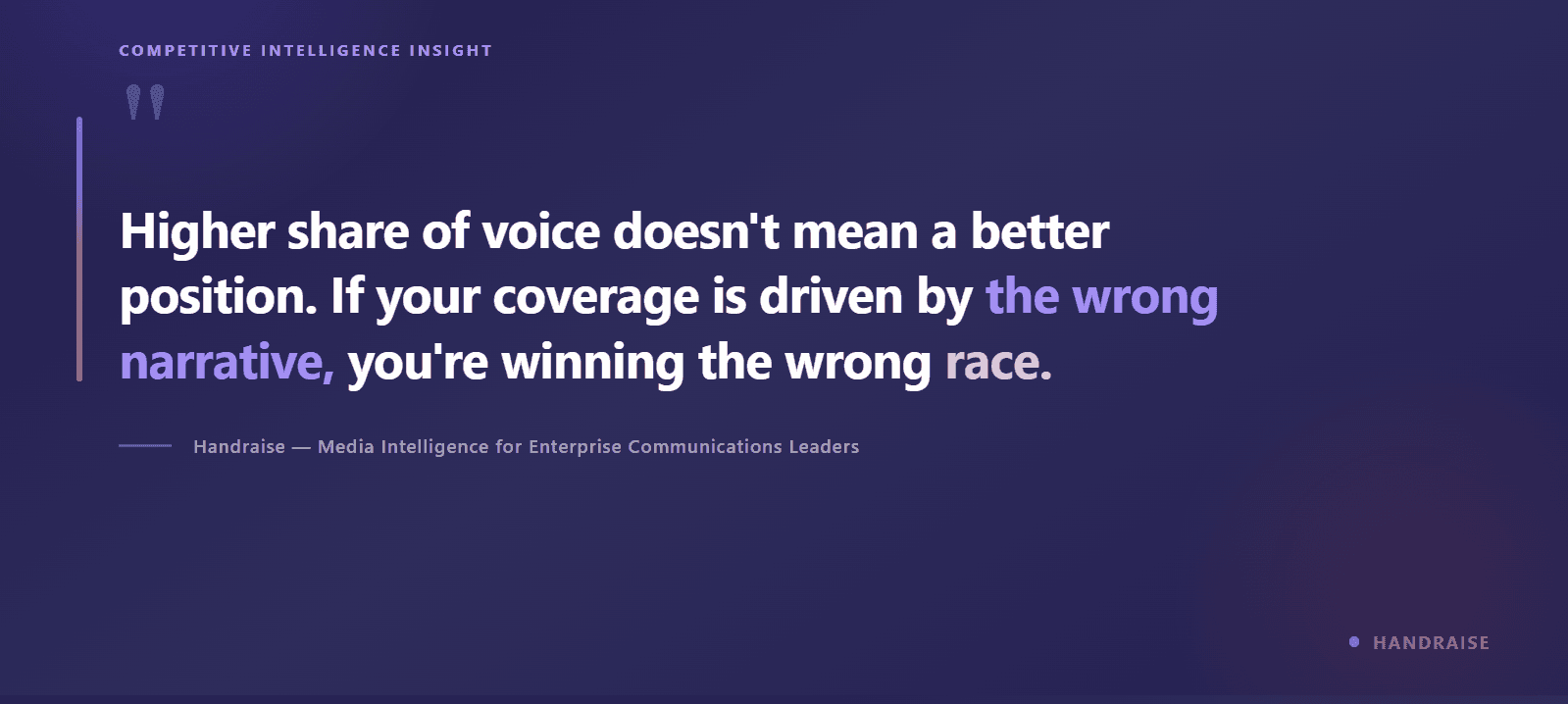
Consider two scenarios: In the first, your brand holds 35% share of voice and the coverage is largely neutral or positive, concentrated in relevant industry publications. In the second, your brand holds 38% share of voice, but a significant portion of that coverage is driven by a controversy narrative that your competitors are actively amplifying. Higher share of voice, worse competitive position.
Dynamic share of voice tracking accounts for these nuances—measuring not just volume, but the quality, sentiment, and narrative framing of coverage across your competitive set. That's the metric that actually tells you whether you're winning.
What High-Performing Communications Teams Do Differently
Enterprise communications teams that use this kind of intelligence most effectively share a few common practices. They've made a deliberate shift from retrospective reporting to forward-looking intelligence, and they've structured their workflows around narrative awareness rather than mention counting.
Here's what separates the leaders from the laggards:
They benchmark against narratives, not just brands. The question isn't just "how do we compare to Competitor X?" It's "who's winning the ESG narrative? The innovation narrative?" and tracking those story threads over time.
They treat publication tiering as a strategic filter. Coverage in high-authority outlets has outsized influence on perception. Elite teams weight their competitive analysis accordingly, prioritizing signal over noise.
They monitor LLM perception alongside traditional media. As generative AI becomes a primary information interface, what AI systems "believe" about a brand—based on the earned media they've indexed—is a legitimate competitive battleground.
They use competitive intelligence to brief agency partners. Smart communications leaders feed their partners a continuous stream of narrative intelligence—which narratives to accelerate, which to neutralize, and where competitors are vulnerable.
They build a feedback loop between intelligence and content strategy. The narrative gaps revealed by competitive data should directly inform earned media strategy, key message development, and spokesperson talking points.

What the Data Tells You About Competitor Vulnerabilities
One underutilized application of a strong competitive intelligence program is vulnerability mapping—identifying where competitors have weak or contested narratives that represent strategic opportunities for your brand.
Every competitive set has narrative gaps. Maybe a key competitor dominates the innovation story but has thin coverage around trust or customer success. Maybe a rival is generating volume but the sentiment pattern shows fragility—high-reach coverage but poor social amplification. These are openings.
A structured approach to narrative analysis surfaces these gaps systematically. When competitors are virtually absent from a high-value narrative category—leadership or industry thought leadership, for example—you have a clear brief for where to direct communications investment.
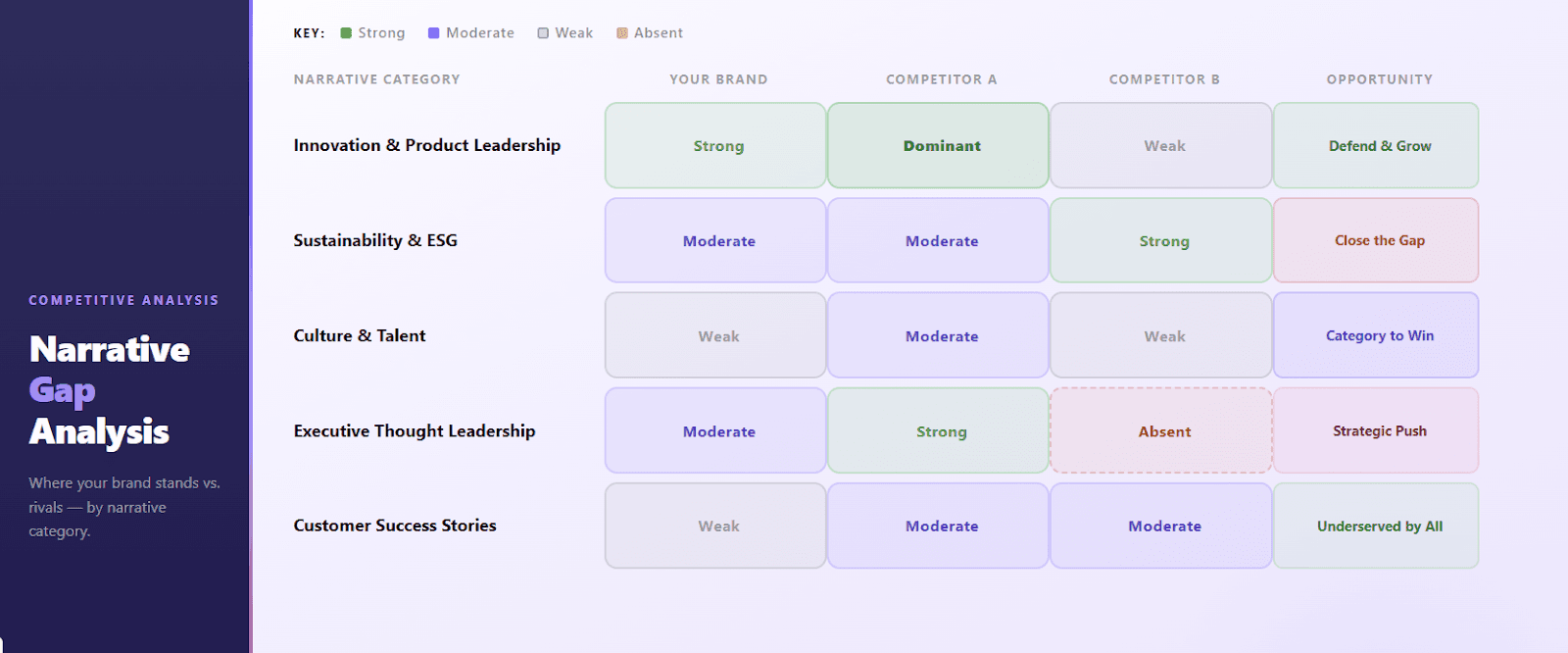
The table below illustrates how narrative gap analysis can translate into strategic guidance:
Competitive Narrative Category | Your Brand | Competitor A | Competitor B | Opportunity? |
Innovation & Product Leadership | Strong | Dominant | Weak | Defend and grow |
Sustainability & ESG | Moderate | Moderate | Strong | Close the gap |
Corporate Culture & Talent | Weak | Moderate | Weak | Category to win |
Executive Thought Leadership | Moderate | Strong | Absent | Strategic push |
Customer Success Stories | Weak | Moderate | Moderate | Underserved by all |
Reading that table, a communications leader can immediately see where to focus earned media and content investment, and where the competitive landscape offers the least resistance.
Frequently Asked Questions
What's the difference between media intelligence and media monitoring? Media monitoring collects coverage based on keyword matches. A true intelligence platform goes further—analyzing, structuring, and interpreting that coverage to reveal narrative trends, competitive positioning, sentiment context, and strategic implications. Monitoring tells you what was published. Intelligence tells you what it means and what you should do about it.
How is share of voice calculated in competitive media intelligence? Share of voice is typically calculated as your brand's coverage volume as a percentage of total coverage across a defined competitive set within a given time period. More sophisticated systems weight this by publication tier, sentiment, and social amplification—providing a more accurate picture of narrative influence rather than raw volume.
Why does publication tiering matter for competitive analysis? Not all coverage carries equal weight. A single story in a high-authority publication can do more to shape brand perception than 50 articles in low-readership outlets. Publication tiering—ranking outlets by domain authority, readership, and relevance—allows communications teams to measure competitive coverage in terms of actual narrative impact rather than mention counts.
How can AI affect brand perception beyond traditional media? Large language models (LLMs) like ChatGPT and Gemini are trained substantially on published earned media. The narratives that dominate your industry's media coverage directly influence how AI systems describe and position your brand when users ask questions. Tracking LLM perception alongside traditional media coverage gives communications leaders a more complete picture of where their brand stands—and where they need to invest.
How often should competitive media analysis be conducted? Legacy workflows run competitive analysis on monthly or quarterly cycles, but by those timelines the strategic window has often closed. High-performing communications teams use real-time or near-real-time intelligence to track competitive narrative movement as it happens—enabling them to respond, pivot, or capitalize within days rather than weeks.
Your Competitive Narrative Doesn't Wait for Your Next Quarterly Report
The communications leaders who will define brand perception in the next five years aren't the ones with the biggest teams or the most media contacts. They're the ones with the clearest, most current picture of the narrative landscape—who's winning which stories, where the gaps are, and what's gaining momentum before it becomes conventional wisdom.
That requires a different intelligence infrastructure than most enterprise teams currently have. It means moving from Boolean searches to AI-powered narrative clustering. From monthly snapshots to real-time competitive tracking. From share of voice as a volume metric to dynamic share of voice as a true strategic signal.
Handraise was built for this moment—bringing together narrative clustering, brand-centric sentiment analysis, publication tiering, and real-time competitive share of voice in one platform designed for communications leaders who need intelligence they can act on. Ready to move beyond legacy media monitoring? Start engineering your reputation with the clarity your brand deserves.
Matt Allison
Founder & CEO
Share