
Key takeaways
- The strongest narrative management strategies give every priority story an owner and a prepared response before it starts moving.
- Start with a narrative map, then cut it to three to five priority narratives sorted into ones you need to own, defend, or enter.
- A brand narrative strategy needs proof points and credible voices behind every claim because assertions without evidence rarely survive pressure.
- Most of the work should be proactive, since a narrative you've fed for months is far easier to protect when it turns.
- AI assistants repeat the narratives they find in coverage, which makes them a stakeholder with a channel plan of their own.
- If your team only talks about a narrative once it's trending, start with the narrative map below.
Narrative management strategies are the routines a communications team uses to decide which stories about the company matter and move them on purpose. Most weeks don't work that way. Someone spots a story in the morning clips, a statement gets drafted, and by Friday, the team is reacting to the next one.
Those reactive statements also fade. In a two-wave experiment published in the Harvard Kennedy School Misinformation Review, a fact-check corrected people's beliefs about a false claim right away, but the effect had faded when the same 1,841 participants were surveyed again roughly 16 days later. A single correction can't hold a narrative in place, so the work needs a routine your team runs every week.
The Complete Guide to Narrative Management explains what narratives are and how they form. This piece is the practical half for leaders who already see why narrative intelligence for communications matters and want the working plan.
What Are the Most Effective Narrative Management Strategies?
The most effective approaches decide in advance which stories matter and what your team will do when each one moves.
Map the narratives around you. List the stories forming about you and the category you compete in.
Choose a short priority list. Pick the three to five narratives that matter most this year.
Build the proof behind each one. Write down the core claim and the evidence behind it.
Feed favorable narratives on a schedule. Line up earned media and data releases against the list.
Prepare responses before you need them. Decide which play you'll run when a narrative turns.
Tailor by stakeholder and channel. Keep the facts identical and change the proof, AI systems included.
Govern and measure. Give each narrative an owner and track direction instead of volume.
How Do You Map the Narratives Shaping Your Brand?
You map narratives by building a one-page inventory of the stories being told about your company and the territory around it. Build it from coverage, analyst notes, social conversation, and what AI assistants say when someone asks about you.
Group coverage into storylines, write each one as a single blunt sentence, and record the fields below. "Coverage is mixed" tells you nothing. "Analysts think our margins can't survive the price war" tells you what proof you'd need. The underlying data comes from monitoring, which Brand Reputation Monitoring: The Complete Guide covers in depth.
| Field | What to record | Example (illustrative) |
|---|---|---|
| Narrative | The story in one plain sentence | "The company is slow to adopt AI" |
| Direction | Growing, steady, or fading | Growing for six weeks |
| Your position | Favorable, unfavorable, or absent | Unfavorable |
| Drivers | The outlets, voices, or events pushing it | Two trade outlets and one analyst |
| Where it appears | News, social, analyst notes, AI answers | Trade press and AI answers |
| Owner | The person accountable for it | Head of corporate communications |
Include the Stories You're Missing From
The most expensive gaps on a map are the stories you aren't in. If a competitor is quoted in most coverage of an industry shift and you aren't, that narrative is being written without you. Absence never shows up in a clip report, so compare presence story by story, the way How Your Brand Story Compares lays out.
How Do You Choose Priority Narratives?
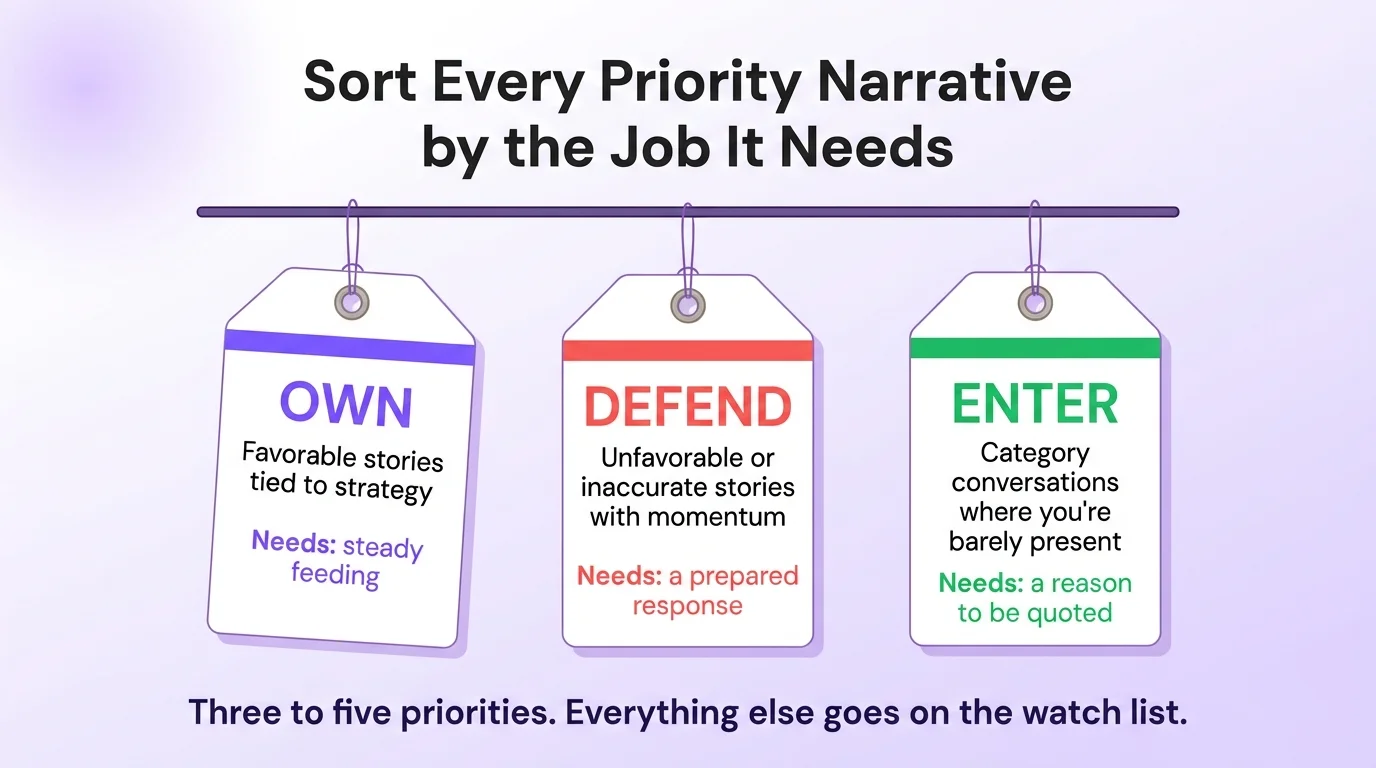
Pick the three to five narratives that most affect your business goals this year and that your team can realistically move. Test each one against your goals. Does it shape a decision someone will make about you, such as whether to invest or regulate? Can you move it with evidence? Does it line up with what leadership is trying to do? Everything that misses goes on a watch list.
Sort the List Into Own, Defend, and Enter
Label each priority by the job it needs. Narratives to own are favorable stories tied to strategy, and they need steady feeding. The ones to defend are unfavorable or inaccurate stories with momentum, which need a prepared response. Category conversations where you're barely present are the ones to enter, and you'll need a reason to be quoted in them. The labels keep one defensive fight from eating the calendar, and they tie narrative work directly to the reputation strategy leadership already signed off on.
What Should a Brand Narrative Strategy Include?
A brand narrative strategy needs a core claim, proof points, evidence assets, credible voices and expected objections, written down before anyone pitches or defends the story. If one is missing, the story gets hard to hold the first time someone pushes back.
Core claim. One sentence your executives would sign.
Proof points. Three to five facts a journalist could verify without calling you.
Evidence assets. Data, customer outcomes, or third-party validation that carries those facts in public.
Credible voices. The executives and outside experts people will believe.
Expected objections. The strongest counter-argument and your honest answer.
Then circulate that one-page brand narrative strategy to every function that speaks for the company. Investor relations and HR each describe the business a little differently from the CEO's office, and those small gaps add up to a story no one planned. Corporate narrative management works when every authorized speaker draws from the same set of facts.
Proactive vs. Reactive: How Should You Balance the Work?
Most of the effort should be proactive because a narrative you've fed for months is far easier to protect than one you start defending the day it turns. Reactive work still matters. It just goes faster when the proactive work is done.
| Proactive work | Reactive work | |
|---|---|---|
| Trigger | The priority list and the calendar | A priority narrative turning against you |
| Main question | What evidence can we add this quarter? | Which response play fits, and who approves it? |
| Typical work | Data releases, executive interviews, customer stories, earned coverage | Clarifying facts, correcting errors, holding statements |
| Pace | Weekly and monthly | Hours to days |
| Success looks like | The story gains independent support | The claim stops spreading and later coverage gets it right |
Build a Narrative Calendar
Map planned moments against each narrative you want to own, such as earnings, product news, research releases, conference talks, and customer milestones. Ask what proof each moment adds. A quarter with no new evidence is a quarter where someone else's framing fills the gap. The calendar also gives agency partners a clear brief on which narratives need to move. It's the simplest way to keep a narrative strategy from living only in a slide deck.
How Do You Build a Narrative Response Strategy?
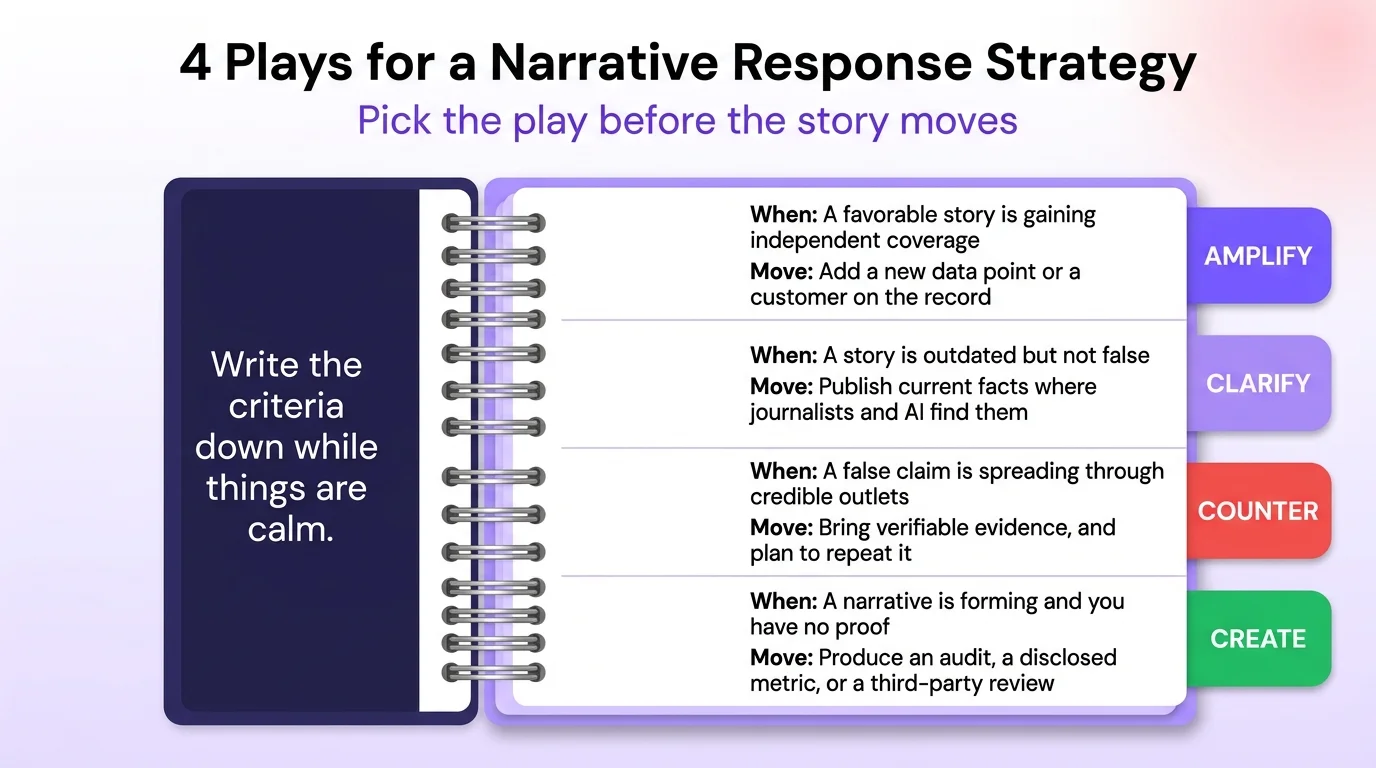
A narrative response strategy decides ahead of time which of four plays you'll run when a priority narrative moves: amplify, clarify, counter, or create. Write the criteria down while things are calm.
Amplify a favorable story that's picking up independent coverage with a new data point or a customer on the record. Don't over-push, since a story that sounds manufactured stops being believed.
Clarify a story that's outdated but not false by publishing current facts where journalists and AI systems will find them. The guide on Inaccurate or Outdated Information About Your Brand covers the AI side.
Counter a false claim spreading through credible outlets with verifiable evidence, and plan to repeat the correction, since a single one tends to fade.
Create evidence when a narrative is forming and you have nothing credible to point to, such as an audit, a disclosed metric, or a third-party review.
What a Real Response Looks Like
The CrowdStrike outage in July 2024 shows these plays under real pressure. Microsoft estimated 8.5 million Windows devices were affected, under one percent of all Windows machines. CEO George Kurtz's first post said it wasn't a cyberattack and that a fix was deployed.
Fortune reported that day that the post left out an apology, and Kurtz added one on television later that morning. The company followed with a preliminary post-incident review and, as TechTarget covered, a full root cause analysis on August 6 that customers and reporters could check for themselves. Clarifying fast helped, but the missing apology became a story of its own.
When Should a Response Escalate?
Escalate when a story starts moving faster than your approved language can handle. Pre-approve holding language for every priority narrative so owners can respond within hours, and send anything beyond those lines to legal and executives. Speed matters most when a story is accelerating, and The Early Signal of Reputation Risk explains how to spot that before volume does.
How Should Your Narrative Strategy Change by Stakeholder?
Keep the facts identical for every audience and change the proof. Investors want disclosed metrics, employees want to hear from their own leaders first, and journalists want data they can verify. When each version traces back to the same brief, you get tailoring without contradiction, which is what corporate narrative management should deliver.
Treat AI Systems as a Stakeholder
AI assistants are now an audience with their own channel plan. Their answers about your company are assembled from published coverage and your public information, so a citation is earned media the AI repeats. You can't edit those answers. You can check how each priority narrative is described, see which sources it leans on, and strengthen the evidence there. Make AI perception a standing line in your reputation strategy.
How Do You Know Your Narrative Management Strategies Are Working?
Measure direction instead of volume, and govern with named owners and a fixed rhythm. For each priority narrative, track whether it's growing or fading, how you're positioned in it, whether your proof points appear in coverage, and how AI systems describe it. A quick readiness check shows whether the program itself is in shape.
If three of your five priority narratives have all three pieces, readiness is 60%, and the two gaps show where next month's work goes.
Set a Governance Rhythm
In larger organizations, corporate narrative management belongs to the CCO, and each priority narrative gets a named owner. Keep reviews short. Each owner reports which way the story moved and what they need. The AI Executive Briefing shows a format leadership will actually read.
Recommended cadence
Weekly owner check-ins, a monthly narrative review with the CCO, and a quarterly priority reset with the executive team.
Fold these reviews into your wider reputation strategy calendar, and adjust the rhythm to your news cycle.
What Should Your Team Do Next?
Start small and make it routine. Here's a checklist for this quarter:
Build a one-page narrative map.
Cut it to three to five priorities and label each one.
Write the claim and proof for each one.
Draft pre-approved holding language and agree who can use it.
Check how AI assistants describe each priority narrative.
Assign owners and book the first monthly review.
Frequently asked questions
Narrative management strategies are the planned practices a communications team uses to identify the stories shaping its reputation, prioritize the few that matter, and influence them with evidence. They usually cover mapping, prioritization, message alignment, proactive programming, response planning, and governance.
A messaging framework tells spokespeople what to say. A narrative strategy decides which external stories the company needs to win, what evidence will move them, and how the team responds when they shift.
Most teams can actively manage three to five. Beyond that, owners get too thin to add new evidence, so extra stories belong on a watch list.
It should name the plays your team can run, the criteria for each, the pre-approved language owners can use without escalating, and the point where legal and executives join.
Turn Your Narrative Map Into a Working Plan
The teams that manage narratives well decide early which stories matter and practice the response before they need it. Handraise was built by the team behind TrendKite for exactly that work, using patented Narrative Clusters™, brand-centric sentiment, and AI perception tracking to show where you stand, plus recommendations on what to amplify, clarify, counter, or create. Explore reputation and narrative management, and book a briefing to see the narratives forming around your brand today.